Quick Enquiry
whatapp icon
phone call

Fab Bath Interiors

Looking For Bulk Orders @ Competitive Prices? Enquiry Now

Download Our Latest Products Catalogue Click Here

info@fabbathinteriors.com

Blog

Your blog category

types of taps

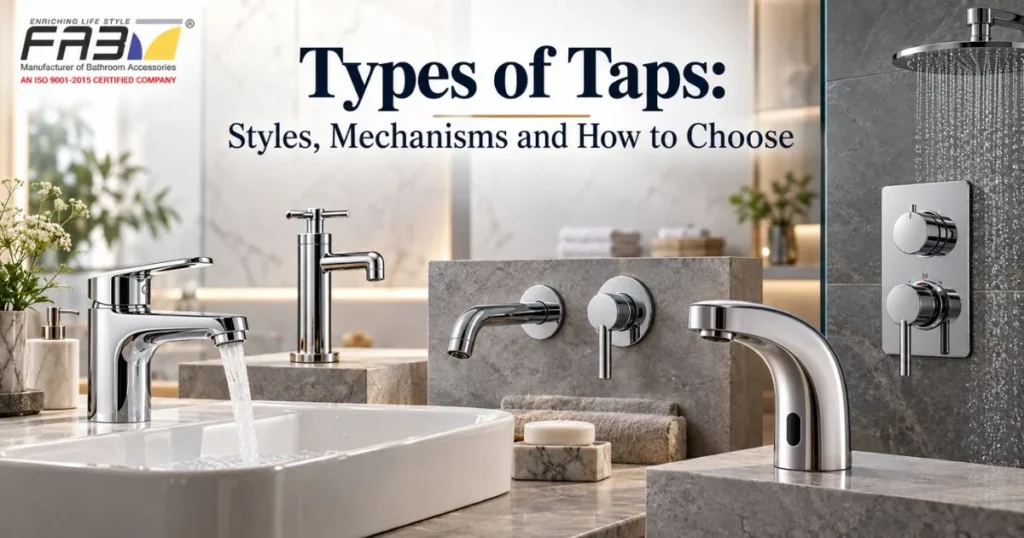
Types of Taps: Styles, Mechanisms and How to Choose

Most homes use one of six main types of taps: pillar, mixer, bib, wall-mounted, sensor or pull-out. Each type differs in how it mixes water, how it mounts, and where it works best. Choosing a tap sounds simple. However, the wrong choice causes leaks, splashing and a poor sink fit. This guide explains every major style in plain language. It also covers internal mechanisms, materials, water-saving standards and buying tips. As a result, you can match a tap to your sink, your water pressure and your budget. Fab Bath Interiors manufactures brass bathroom fittings in Jamnagar, India. The company supplies buyers across Europe, the Middle East and South-East Asia. That production experience shapes the practical advice below. What Are the Main Types of Taps? Taps fall into three groups. First, the design and mounting style decides how a tap looks and fits. Second, the internal mechanism decides how it opens, closes and ages. Third, the body material decides strength and safety. Therefore, all three groups matter when you compare types of taps. For example, a bathroom mixer and a garden bib tap can both use a ceramic cartridge. However, their shapes, mounting points and finishes differ completely. The sections below cover each group in turn. Use them as a quick reference before you buy, replace or specify any tap. Types of Taps by Design and Mounting Seven styles cover almost every home, hotel and commercial project. Each one solves a different sink, wall or workflow problem. Pillar Taps Pillar taps use two separate handles, one for hot water and one for cold. Each handle sits on its own base over a sink hole. As a result, the water mixes only in the basin, not inside the tap. Many buyers love this classic look. In addition, pillar taps suit traditional bathrooms and heritage interiors. However, you cannot fine-tune the temperature with one hand. Some users also find the split flow awkward for face washing. Mixer Taps Mixer taps blend hot and cold water inside one spout. You set the temperature with one lever or two handles. Consequently, the water leaves at the right heat without a second adjustment. Single-lever mixers work well in modern kitchens and bathrooms. Moreover, they save time and water. However, mixers need reasonably balanced hot and cold pressure. Otherwise, one supply can dominate the other. Monobloc Taps A monobloc tap combines the spout and handle in one compact unit. It fits through a single hole in the sink or countertop. Therefore, it looks clean and suits small basins well. Cleaning is also easier because the tap has fewer gaps. Technically, a monobloc is a mixer tap. Yet it needs only one drilled hole, which simplifies installation. Bib Taps A bib tap has a horizontal inlet and a downward spout. It mounts on a wall, usually outdoors or in utility areas. Gardens, garages and laundry rooms commonly use bib taps. Because the design is simple, these taps cost less and repair quickly. Also, many versions accept a hose connector. Wall-Mounted Taps Wall-mounted taps come out of the wall instead of the sink or countertop. This keeps the counter clear and looks sleek. For example, designers often pair them with vessel basins. However, the plumbing sits inside the wall, so installation needs planning. Repairs are harder, too. Therefore, choose a high-quality body from the start. Sensor Taps Sensor taps open automatically when a hand comes near. They switch off soon after use. As a result, they cut water waste and reduce surface contact. Airports, hospitals and offices use them widely. In addition, homes with young children or older adults benefit from touch-free control. However, sensor taps need batteries or mains power, and that adds maintenance. Pull-Out and Pull-Down Taps These types of taps have a spray head on a flexible hose. You pull the head toward the sink or pot. Consequently, rinsing and cleaning become far easier. Kitchen sinks use them most often. Furthermore, dual-function heads switch between a stream and a spray. Check the hose weight and retraction, because a weak counterweight causes sagging. Types of Taps by Internal Mechanism The mechanism inside a tap decides how smoothly it turns and how long it lasts. Four designs dominate the market. Compression taps press a rubber washer onto a seat to stop the flow. Ball taps use a slotted ball to control mixing. Cartridge taps slide a stem inside a sealed unit. Ceramic disc taps rotate two polished discs against each other. Mechanism How it seals Handle action Upkeep Compression Rubber washer on a seat Several turns Washers wear out and need replacing Ball Slotted ball in the body Single lever Many small seals can leak over time Cartridge Sliding stem in a sealed unit Single lever Replace the whole cartridge Ceramic disc Two polished ceramic discs Quarter turn or lever Very durable and rarely drips Overall, ceramic disc cartridges give the best balance of smooth feel and durability. In contrast, compression taps cost less but drip once the washer hardens. Therefore, buyers who want low maintenance should look for ceramic disc mechanisms inside a solid brass body. Pillar vs Mixer vs Monobloc Taps: Which Should You Choose? Pillar, mixer and monobloc taps are the three closest choices for a bathroom basin. The table below compares them side by side. Feature Pillar tap Mixer tap Monobloc tap Sink holes needed Two One to three One Water mixing In the basin Inside the spout Inside the spout Best for Traditional bathrooms Kitchens and modern bathrooms Compact basins and counters Cleaning effort Higher, with more gaps Moderate Lowest In short, pick a pillar tap for period styling and a mixer for blended water. Pick a monobloc for compact sinks. However, the number of holes in your sink often makes the final decision. Measure it first, because drilling porcelain or stone is risky. Best Types of Taps for Bathroom, Kitchen and Outdoor Use Every room asks something different from a tap. Match the style to the task, not just the look.

Types of Taps: Styles, Mechanisms and How to Choose Read More »

Types of Mortise Handles

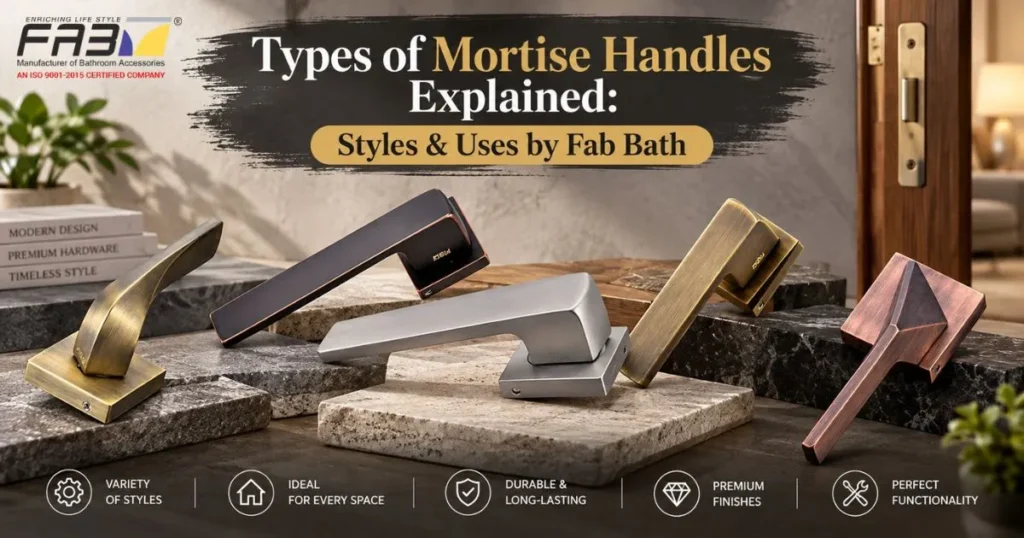
Types of Mortise Handles Explained: Styles & Uses by Fab Bath

Mortise handles are door handles fitted into a rectangular pocket cut into the door edge. The main types of mortise handles are lever-on-rose, D-shape, rectangular, round plate, long plate, and pull-style designs. Each type suits a different door thickness, security need, and interior look. Before you buy, here’s what most people want to know first: What Is a Mortise Handle? A mortise handle is the outer grip of a mortise lock system. The lock body, latch, and handle work as one unit. This is different from a cylindrical or tubular lock, where the handle and latch are separate parts. As a result, mortise handles feel sturdier. They also last longer under daily use. Architects often choose mortise systems for their strength. The lock body carries most of the load. So the handle only needs to move the latch smoothly. This is why mortise handles remain the standard pick for front doors, hotel rooms, and commercial entrances across India. Before comparing the types of mortise handles below, note that most Indian mortise sets use a 60mm or 70mm backset. That’s the distance from the door edge to the centre of the spindle. Always check this measurement before you order a replacement handle. Types of Mortise Handles Explained Manufacturers group the types of mortise handles by shape, mounting style, and use. Here’s how each one differs, and where it fits best. Lever-on-Rose Mortise Handles Lever-on-rose handles sit on a small circular or square plate called a rose. They give a minimal, modern look. This style suits contemporary homes, apartments, and offices well. Because the rose is compact, it also works on slim door stiles where a longer plate wouldn’t fit. D-Shape (Pin) Mortise Handles D-shape, or pin-type, handles have a curved profile shaped like the letter D. They offer a firm grip and a slightly heavier look. Many hotels and premium homes choose D-shape handles for main entrance doors. The design signals quality without looking too ornate. Rectangular Mortise Handles Rectangular handles pair a straight-edged plate with a matching lever or knob. The geometric shape suits minimalist and industrial interiors. Designers often specify rectangular mortise handles for glass-panelled doors and steel-frame partitions, where clean lines matter most. Round Plate Mortise Handles Round plate handles use a circular backplate instead of a rectangular one. This type of mortise handle fits narrower door edges well. It gives a softer, more traditional look than rectangular options. It’s a practical choice for bedroom and study doors. Long Plate Mortise Handles Long plate handles run the height of the lock body. One continuous plate covers both the latch and the lock cylinder. This design hides scratches near the keyhole. It also adds a formal, symmetrical look. Long plate handles suit main doors and boardroom entrances, where presentation matters as much as function. Pull-Style Mortise Handles Pull-style, or bar, mortise handles combine a fixed pull bar with a separate operating lever below or beside it. This type works well on heavy timber or double-shutter doors that see frequent use. Hotels and commercial lobbies often pick pull-style handles because they’re easy to grip, even with wet or full hands. Mortise Handle Materials and Finishes Brass is the standard base material for Indian mortise handles. It resists corrosion, and it takes finishes well. On top of solid brass, manufacturers apply a coating to change the look and boost wear resistance. Fab Bath Interiors’ mortise handle collection covers this full finish range. Options include S.S. (Steel Satin), Antique Brass, Black Matt, Satin Lacquer, Chrome, Copper Antique, Black Gold, Black Copper, and PVD finishes such as Rose Gold and Gold. PVD, or Physical Vapour Deposition, finishes cost more than standard electroplating. However, they resist scratching and fading far better. This matters most on high-traffic doors, such as a main entrance or a hotel corridor. When you compare finishes, match the metal tone to your other hardware. Taps, cabinet pulls, and light fixtures should share a similar tone. As a result, the room reads as one design, not several unrelated choices. A quick wipe with a soft, dry cloth every week also keeps most finishes looking new for longer. Mortise Handles for Different Spaces Not every door needs the same type of handle. Here’s a quick match-up by room or building type. Mortise Handles vs Cylindrical vs Tubular Handles Buyers often mix up mortise, cylindrical, and tubular locksets. The table below compares all three on the factors that matter most. Feature Mortise Handle Cylindrical Lock Tubular Lock Installation Cut into door edge; more labour Drilled through door; faster Drilled through door; fastest Strength Highest — lock body reinforces the door Moderate Lower Best for Front doors, hotels, offices Bedroom, bathroom doors Interior or closet doors Typical price (India) ₹300–₹3,000+ ₹200–₹1,500 ₹150–₹800 Security grade Up to Grade 1 (ANSI/BHMA) Grade 1–3 Grade 3 Mortise handles cost more to fit. However, the extra strength and finish choices make them the preferred option wherever a door sees heavy daily use. How to Choose the Right Type of Mortise Handle With so many types of mortise handles on the market, a few practical checks can save you from a mismatched or wobbly handle later. Installation and Maintenance Tips Fitting a mortise handle takes more care than a tubular lock, but the process is straightforward for a trained carpenter. First, the mortise pocket must match the lock body’s exact dimensions. A tight fit prevents the lock from rattling later. Once fitted, most mortise handles need very little upkeep. Wipe the handle weekly with a dry or slightly damp cloth. Avoid harsh chemical cleaners, since they can strip PVD and lacquer finishes over time. If a lever starts to feel loose, tighten the grub screw on the underside of the rose or plate before it wears the spindle further. For coastal or humid regions, choose PVD or chrome finishes over antique brass. These resist tarnishing better in salty or damp air, which keeps the handle looking new for years. Cost Factors for Bulk and Project Buying Price varies

Types of Mortise Handles Explained: Styles & Uses by Fab Bath Read More »

Luxury bathtub accessories

Luxury Bathtub Accessories: The Complete 2026 Buying Guide

Luxury bathtub accessories are premium add-ons built around the tub itself. The list covers caddy trays, bath pillows, tub fillers, hand showers, grab bars and non-slip mats. Good ones use solid brass, SS 304 or sealed teak. Here is what most buyers ask first: What Are Luxury Bathtub Accessories? Luxury bathtub accessories are the hardware that turns a plain tub into a usable spa. Think caddy trays, headrests, freestanding fillers, hand showers, towel rails and safety bars. The difference sits in three places: the base material, the waterproofing, and the fit. Budget pieces use coated plastic, thin aluminium or untreated wood. Premium pieces use solid brass, grade 304 stainless steel, teak or sealed stone. As a result, the premium piece handles steam, soap and constant wetting. The budget piece swells, stains or rusts inside a year. For example, an unsealed bamboo tray warps within two monsoons in most Indian homes. In addition, fit matters just as much. A caddy sized for a 70-inch tub will slip on a 60-inch one. Therefore, measure the outer rim before you order anything that bridges the tub. Materials: What Luxury Bathtub Accessories Are Made Of Material decides how long luxury bathtub accessories last. Check the spec sheet before you check the price tag. Solid brass – It suits fillers, hand showers and wall hardware. It is heavy, corrosion-resistant, and it holds PVD finishes well. Moreover, it tolerates hot water far better than zinc alloy. SS 304 stainless steel – SS 304 stainless steel is the safe choice for racks, bars and frames. In practice, it resists humidity and hard water without pitting. However, SS 202 costs less and rusts near the welds, so confirm the grade in writing. Teak and stone – Teak is the classic tray material. Its natural oils repel water, and it feels warm against wet skin. Still, teak needs oiling once or twice a year. Marble, travertine and quartz appear in soap dishes and tub-side tables. As a rule, these need annual sealing, especially where bath oils are used. Luxury Bathtub Accessories vs. Standard and Premium Ranges Buyers usually weigh three tiers. The table below sets them side by side. Feature Standard (budget) Premium (mid-range) Luxury Tray material Plastic, bamboo Coated steel, rubberwood Solid teak, brass, SS 304 Metal finish Thin electroplating Powder coating PVD, hand-brushed Typical lifespan 1-3 years 4-7 years 12-20 years Adjustable fit Rare Sometimes Standard on trays and bars Price per piece Rs 400 – Rs 1,200 Rs 1,200 – Rs 3,500 Rs 1,500 – Rs 12,000 Finish options Chrome only Chrome, black Chrome, matte black, gold, rose gold, nickel In short, the luxury tier costs two to four times more upfront. Nevertheless, it outlives three budget sets. As a result, the lifetime cost usually favours the better piece. The Nine-Piece Kit Most Tubs Need In practice, a complete tub setup needs nine pieces. Buy them together so the finishes match. Clearly, safety gear is not optional. Grand View Research reports that grab bars are the fastest-growing product segment in the global bathroom accessories market. That growth tracks ageing households, meaning safety hardware now sits inside premium design briefs, not outside them. How to Choose a Bath Caddy Tray That Actually Fits The caddy is the piece buyers get wrong most often. Measure first, then shop. First, measure the outer width of your tub, rim to rim. Add nothing for tolerance, because good trays expand on their own. Most quality trays extend between 65 cm and 95 cm. Next, check the stopper design. Fixed stoppers slip on rolled-rim tubs. Pivoting or rubber-tipped stoppers grip far better. Then look at the slots. A book rest, a tablet groove and a wine or tea recess each serve different habits. Choose the layout you will actually use. Finally, weigh the tray in hand if you can. A heavy teak tray stays put. A light plastic one slides the moment you lean on it. Tub Fillers, Hand Showers and Water Efficiency Luxury bathtub accessories increasingly include performance plumbing, not just trays and pillows. Freestanding fillers, thermostatic valves and multi-spray hand showers now appear in mid-budget renovations. Flow rate is the number to watch. The US Environmental Protection Agency notes that standard showerheads use 2.5 gallons per minute. WaterSense-labelled models use no more than 2.0. The agency estimates an average family saves around 2,700 gallons a year after switching. That means lower bills and less load on your geyser. Thermostatic control is the second upgrade worth paying for. It holds the set temperature even when someone opens another tap. Consequently, it protects children and older users from sudden scalding. How Much Do Luxury Bathtub Accessories Cost in India? Pricing depends on material, finish and brand positioning. Below is a realistic 2026 range for the Indian market. Teak caddy trays start near Rs 2,500. Brass hand showers with hoses start near Rs 3,500. Freestanding tub fillers sit far higher, usually between Rs 18,000 and Rs 60,000. A complete nine-piece kit costs roughly Rs 25,000 to Rs 70,000 per bathroom, excluding the filler. Add installation at Rs 200 to Rs 600 per piece for wall-mounted items. Context helps here. According to Grand View Research, the global bathroom accessories market was worth about USD 24.6 billion in 2024. It should reach USD 46.23 billion by 2030. India is expected to post the highest growth rate in that period. That means buyers here will see more design choice and sharper pricing. Installation and Fitting That Protects Your Investment Even the best luxury bathtub accessories fail when fitted badly. Therefore, treat installation as part of the purchase. Grab bars must anchor into structural backing, never into tile alone. Use stainless steel or brass fasteners with nylon plugs. Plan your door hardware and lock system in the same round, so every finish matches. Mounting heights matter for comfort. A tub grab bar works at 33 to 36 inches above the floor, as ADA accessibility guidelines recommend. Hand shower brackets sit well at 48 to 52 inches.

Luxury Bathtub Accessories: The Complete 2026 Buying Guide Read More »

types of locks

7 Types of Locks for Indian Home | Full Guide by Fab Bath Interiors

Types of locks fall into seven main categories: mortise, cylindrical, deadbolt, padlock, smart, rim, and magnetic locks. Each one suits a different door, budget, and security level. The right type of lock depends on where you’re installing it and how much protection you actually need. Here’s what you need to know before you buy: This guide by Fab Bath Interiors breaks down all seven types of locks. It shows you which one fits which door, and it helps you avoid the hardware mistakes most homeowners make. This guide draws on hands-on experience specifying door hardware for Indian homes and renovation projects. For example, many of the coating and backset recommendations below come directly from real installation call-backs on humid bathroom doors. As a result, the advice here reflects what actually holds up over years of daily use, not just a manufacturer’s spec sheet. However, always confirm current certification and warranty terms with your supplier, since standards and product lines change over time. What Are the 7 Types of Locks? Quick Comparison If you only have a minute, here’s the short version. The table below compares the seven types of locks by best use, average cost in India, and security level. Scan it, then jump straight to the section you need. Lock Type Best For Security Level Approx. Cost (INR) Mortise Lock Main entry doors High ₹1,500–₹5,000 Cylindrical Lock Bedroom, bathroom doors Medium ₹600–₹2,000 Deadbolt Lock Front doors, extra security Very High ₹1,000–₹3,500 Padlock Cabinets, gates, storage Medium ₹200–₹1,500 Smart Lock Main doors, keyless entry High ₹5,000–₹15,000 Rim Lock Budget interior doors Low–Medium ₹300–₹900 Magnetic Lock Glass doors, cabinets Low–Medium ₹500–₹2,500 As a result, most homes end up using at least three of these type of locks across different rooms. Very few homes rely on just one. Mortise Locks: Best for Main Doors A mortise lock sits inside a pocket cut into the edge of the door. It doesn’t sit on the surface like other hardware. This makes it one of the sturdiest types of locks for main entrances. The lock body houses the latch and bolt together. As a result, it resists forced entry better than surface-mounted hardware. Most Indian homes use a mortise lock on the main door, since it combines a handle, latch, and key lock in one unit. For example, a three-lever or five-lever mortise lock offers a strong balance of cost and security. It works well for most apartment entrances. However, mortise locks need a professional installer, because the door itself must be chiseled to fit the lock body. If you’re renovating a main door, pair a mortise lock with a night latch. This gives you two independent locking points. It’s a simple way to raise your home’s security without a full hardware overhaul. Cylindrical Locks: Best for Bathroom and Interior Doors Cylindrical locks are the round-knob or lever-handle locks you see on bedroom and bathroom doors. The mechanism sits in a hole bored straight through the door face. This makes installation faster than a mortise lock. Bathroom doors need privacy rather than heavy security. As a result, cylindrical locks with a simple privacy turn-button are the standard choice. Most interior design brands, including bath hardware suppliers, recommend cylindrical locks for wet areas. Look for a rust-resistant finish, such as stainless steel or PVD coating. Bathroom doors face humidity every day, and an uncoated lock body can seize up within a year in a humid Indian bathroom. A privacy cylindrical lock with an emergency-release slot is worth the small extra cost. It lets someone unlock the door from outside during a real emergency. Deadbolt Locks: Best for Extra Security A deadbolt lock throws a solid metal bolt directly into the door frame. It has no spring mechanism, unlike a standard cylindrical or rim lock. This is why deadbolts resist kicking and prying far better. Single-cylinder deadbolts use a key outside and a thumb-turn inside. This setup works well for most Indian front doors. Double-cylinder deadbolts need a key on both sides, which adds security. However, you also need a key handy to exit during a fire, so check local safety codes first. For example, pairing a deadbolt with an existing mortise lock creates two separate points of failure. An intruder has to defeat both, which is a standard recommendation from home-security consultants. Padlocks: Best for Cabinets, Gates, and Storage Padlocks are portable, detachable types of locks. They clip through a hasp or shackle point instead of mounting inside the door. This makes them the most flexible lock type, since you can move them between gates, cabinets, and storage units. For instance, choose a hardened steel shackle for an outdoor gate. Cheaper brass shackles can be cut with basic tools in seconds. For bathroom or utility cabinets, a smaller brass padlock is usually enough, since the goal is child safety rather than theft prevention. However, a padlock is only as strong as the hasp it’s attached to. A high-security padlock on a flimsy hasp still leaves a weak point. You May Also Like This – Best Place for Towel Stand Smart Locks: Best for Keyless Convenience Smart locks replace or supplement a physical key with a PIN pad, fingerprint scanner, or smartphone app. They’re increasingly common on main doors in Indian apartments and gated communities. A smart lock logs every entry. As a result, it works well for households that want to track when family members, staff, or delivery visitors come and go. Most models also include a physical key override for power failures, so you’re never locked out during an outage. For example, a fingerprint-and-PIN smart lock lets each family member use their own access method. This removes the daily hassle of remembering or sharing keys. Smart locks cost more upfront. However, many homeowners find the convenience worth it once they stop worrying about lost keys. Rim Locks: Best for Budget Interior Doors A rim lock mounts on the surface of the door instead of inside it. This makes it the easiest and cheapest type

7 Types of Locks for Indian Home | Full Guide by Fab Bath Interiors Read More »

best place for towel stand

Best Place for Towel Stand in Your Bathroom (2026 Guide)

Most homeowners buy a towel stand first. Then, they figure out placement later. That order is backwards. In practice, the best place for towel stand installation gets decided before the wall is even tiled, not after. Above all, a towel stand for bathroom fitting depends on that early decision. For example, get the position wrong, and even a solid brass fitting will feel cramped, block the door, or stay permanently damp. Have you ever reached across a shower cubicle for a towel? Or knocked your elbow on a stand every time the door opens? You already know the frustration. Indeed, a towel stand in the wrong spot does not just look awkward. It makes the bathroom harder to use every single day. This guide by Fab Bath Interiors fixes that. Specifically, it walks through the exact placement rules our fitting team uses, the Vastu-based positions Indian buyers ask about most, and the material choice that decides how long a towel stand for bathroom use actually survives in humid conditions. The best place for a towel stand is within easy reach of the shower or bathtub, at least 300mm away from the direct water-spray zone, on a load-bearing wall that allows proper anchoring. This keeps towels dry between uses, avoids water contact that corrodes lower-grade metal, and stops the stand from blocking movement around the sink or door. Best Place for a Towel Stand in a Small Bathroom In a small bathroom, the best place for towel stand fitting is rarely the spot buyers first imagine. Indeed, a compact towel stand for bathroom use needs even more care in tight layouts. Most people default to the wall opposite the door, because it looks balanced on paper. However, that wall is usually the one you walk past most often. As a result, a protruding stand there becomes a constant obstacle. Instead, measure the door swing first. Then, mark where the arc ends. Next, look for the nearest flat wall segment outside that arc — that is your safe zone. Specifically, a single-bar or double-bar towel stand fits well on a side wall next to the washbasin, roughly 900mm to 1,100mm from the floor. This height, in turn, keeps a towel stand for bathroom use accessible for adults, without forcing anyone to bend or stretch. Quick checklist for small-bathroom placement: In short, small-bathroom planning always starts with the door, not the wall. Vastu Guidelines for Towel Stand Placement Vastu Shastra treats the bathroom as a space governed by water and fire elements. Thus, towel placement follows specific directional rules. According to tradition, the best place for towel stand positioning is the southeast or south wall, the zone linked to fire energy, which is believed to support faster drying. The northeast corner, by contrast, is generally avoided. This corner is considered the water and spiritual zone in Vastu. Consequently, placing a damp towel there is thought to disturb that balance. Similarly, consultants often advise against hanging a towel stand for bathroom use directly opposite the main door, since it is believed to block energy flow into the space. Beyond the symbolic reasoning, there is a practical overlap worth noting. Notably, the southeast wall in most Indian home layouts also receives more natural ventilation than interior corners. That, in turn, genuinely helps towels dry faster. So, the Vastu-recommended zone and the functionally best place for towel stand positioning often line up. 💡 Key Insight: In our fitting consultations, close to four out of five Vastu-conscious buyers ask for southeast-wall installation first, before any discussion of bar length or finish. Wall-Mounted vs Freestanding Placement Choosing between a wall-mounted and a freestanding towel stand for bathroom use changes where placement even becomes possible. Wall-mounted stands need a fixed vertical surface with enough depth for anchors. This detail decides whether you have truly found the best place for towel stand fitting. Freestanding stands, on the other hand, need floor clearance instead, usually a footprint of at least 350mm by 350mm outside any walking path. Factor Wall-Mounted Towel Stand Freestanding Towel Stand Ideal placement Fixed wall near basin or shower Open floor space, corner, or beside bathtub Space required Wall depth only 350mm x 350mm floor footprint minimum Best for Bathrooms under 40 sq ft Larger bathrooms, rental units, flexible layouts Installation Requires drilling and anchoring No drilling — repositionable Stability in humid zones Very high with brass fittings Moderate, depends on base weight Typical lifespan (Fab Bath brass units) 12–15 years with routine care 8–10 years with routine care Source: Fab Bath Interiors internal fitting-durability records, Jamnagar production facility, 2024–2026. Generally, renters prefer a freestanding towel stand for bathroom flexibility. After all, nothing needs to be drilled into a wall that belongs to a landlord. Homeowners doing a full renovation, on the other hand, tend to choose a wall-mounted towel stand for bathroom durability. Similarly, wall-mounted brass fittings last longer and do not shift position when towels get pulled off quickly. Best Place for Towel Stand Near the Shower or Bathtub The single most common question we get is where to position a towel stand for bathroom use relative to the shower. Specifically, the best place for towel stand installation near a shower cubicle is on the wall adjacent to the shower door, not facing it. It should sit outside the direct spray radius, even with the door open. Here is a useful rule from our fitting team: measure 300mm outward from the shower door’s fully open position. This single rule solves most best place for towel stand questions we hear about shower zones. Do not place a towel stand for bathroom use inside that radius. Splash inside that zone is frequent enough to keep towels perpetually damp. Consequently, that dampness shortens fabric life and, over years, accelerates corrosion on lower-grade metal fittings. For bathtubs, the calculation is slightly different, because splash tends to stay closer to the tub edge itself. Bathtub-side placement is a common towel stand for bathroom question on its own. In this case,

Best Place for Towel Stand in Your Bathroom (2026 Guide) Read More »

top 10 bathroom fittings brands in india

Top 10 Bathroom Fittings Brands in India 2026 | Guide by Fab Bath

Most “top 10 bathroom fittings brands in india” lists are recycled from the same five sources, ranked by ad spend rather than actual product quality. That’s the gap. Anyone shortlisting fittings for a new build or renovation ends up comparing brand logos instead of brass grades, plating durability, or after-sales warranty terms — the things that actually determine whether a tap survives five years of hard water. This guide by Fab Bath Interiors fixes that by ranking brands on material specification, not marketing budget, and by explaining exactly what separates a ₹500 fitting from a ₹5,000 one. If you’re sourcing at scale — for a hotel project, a builder pipeline, or a distribution network — this comparison also flags which brands actually export-grade their brass and which sell the same SKU under two different quality tiers. Top 10 bathroom fittings brands in India refers to the manufacturers and suppliers most commonly specified by architects, builders, and interior designers for taps, showers, faucets, and bathroom hardware across residential and commercial projects in India, ranked by material quality, finish durability, and after-sales support. How We Ranked These Brands Most comparison articles rank brands by search volume or affiliate commission. We ranked on four criteria that actually predict how a fitting performs after installation: Top 10 Bathroom Fittings Brands in India Compared Brand Known For Typical Price Tier Best Suited For Jaquar Wide retail network, design range Mid-Premium Residential, mid-size builders Kohler Premium design, sanitaryware + fittings Premium Luxury residential, hospitality Hindware Value-for-money, broad SKU range Entry-Mid Mass housing, budget renovation Cera Affordable, growing distribution Entry Budget projects, tier-2/3 cities Parryware Roca-backed, consistent quality Mid Residential, apartments Grohe German engineering, premium cartridges Premium Luxury residential, commercial Roca Spanish design heritage Premium Hospitality, high-end residential Essco Industrial-grade, project supply Mid Commercial, institutional Marc Contemporary design focus Mid-Premium Residential, boutique projects Fab Bath Interiors Brass-grade specification transparency, project-based sourcing Mid-Premium Builders and suppliers who need documented brass composition, not just a brand name This isn’t a paid ranking, and price tier isn’t the same as quality — a Cera fitting installed correctly with the right brass grade will outlast a mismatched premium fitting installed with the wrong valve seat. What matters more than the logo is the next section. Brass Grade — The Spec Sheet Detail Nobody Explains Here’s what most buyers never ask, and what most spec sheets never volunteer: not all “brass” fittings use the same brass. In practice, what we find is that most buyers never see this distinction written anywhere on the packaging — it only shows up if you ask the manufacturer directly or read the technical data sheet, which almost nobody does before purchase. This is exactly why brands selling into hard-water regions or export markets specify grade 385 as a baseline, while brands competing purely on shelf price default to 360. 💡 Key Insight: If your project is in a hard-water zone — most of North India qualifies — ask for the brass grade in writing before ordering, not just the finish type. Table Snippet: Brass Grade Comparison Property Grade 360 Grade 385 Copper content ~60% ~63-65% Corrosion resistance Moderate High Machinability Excellent Good Typical use case Entry/mid fittings Premium/export fittings Common in Budget retail SKUs Architectural, hospitality, export Branded vs Unbranded — What You’re Actually Paying For Ready your budget for a genuinely useful comparison, not a brand-loyalty pitch. Plain talk: what does the brand name actually buy you? What it does not automatically buy you is better brass. Several regional and B2B suppliers — including Fab Bath Interiors, working out of Jamnagar’s brass manufacturing belt — supply grade-385 fittings at a lower markup because they sell direct to builders and distributors rather than through multi-layer retail channels. The most common mistake we see is buyers assuming “unbranded” means “lower quality,” when in Jamnagar’s manufacturing ecosystem it often means “fewer markup layers between the factory and the buyer.” How to Choose a Bathroom Accessories Supplier in India If you’re sourcing at project scale rather than buying one tap for a home renovation, the decision changes. A good Bathroom Accessories Supplier in India should be evaluated on different criteria than a retail brand. Quick answer: for project sourcing, prioritize a supplier who provides written brass-grade documentation, holds consistent stock for repeat orders, and offers direct factory pricing — not necessarily the supplier with the most recognizable brand name. Here’s the checklist we recommend to builders and distributors evaluating a Bathroom Accessories Supplier in India: Vastu Considerations for Bathroom Fittings Placement Since fittings and bathroom layout decisions are often made together in Indian residential projects, it’s worth noting: Vastu Shastra principles generally recommend bathroom fittings — taps, showers — positioned toward the east or north walls, with the drainage point oriented northeast where possible. This is a design and cultural consideration, separate from material quality, and worth discussing with your architect alongside the fittings selection itself. Frequently Asked Questions Which brass grade is best for bathroom fittings in hard-water areas?  Brass Grade 385 is better suited to hard-water regions because of its higher copper content and stronger resistance to dezincification.  Is a more expensive bathroom fittings brand always better quality?  Not necessarily. Price often reflects brand marketing, retail markup, and design range rather than material composition alone. What is the difference between a bathroom fittings brand and a bathroom accessories supplier? A Bathroom Accessories Supplier in India, especially manufacturer-linked suppliers, often sells directly to builders and distributors at factory pricing, with more flexibility on customization and bulk documentation but less retail-facing brand recognition. How do I verify the brass grade of fittings before buying?  Request a material composition certificate directly from the manufacturer or supplier. Legitimate suppliers, including project-focused ones like Fab Bath Interiors, can provide this on request. Do all top 10 bathroom fittings brands in India use the same manufacturing standards? No. While most established brands comply with baseline ISI and IS 8931 standards for plating and pressure ratings, brass grade, cartridge type, and finish durability

Top 10 Bathroom Fittings Brands in India 2026 | Guide by Fab Bath Read More »

Liquid holder manufacturer in india

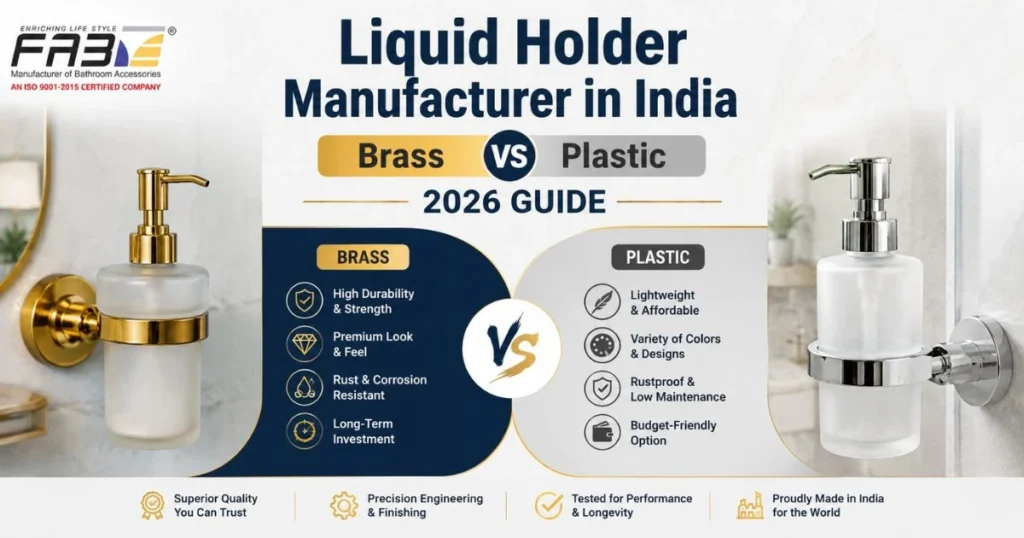
Liquid Holder Manufacturer in India: Brass vs Plastic 2026 Guide

Search “liquid holder manufacturer in india” today. Almost every result sells the same thing. A plastic pump dispenser, priced under ₹100. That’s fine for a home countertop. It is not what a hotel chain needs. It is not what an architect specifies for a five-star bathroom. A brass liquid holder is a different category entirely. It’s wall-mounted. It’s built for years of daily use and manufactured to match a bathroom’s other brass fittings. This guide by Fab Bath Interiors breaks down what separates a genuine liquid holder manufacturer from a plastic dispenser seller. It also covers what to check before you place a bulk order. What a Liquid Holder Actually Is A liquid holder is a wall-mounted bathroom fitting. It holds and dispenses liquid soap or handwash. Some call it a liquid soap holder. Others call it a liquid dispenser fitting. Unlike a plastic pump bottle, a real liquid holder is part of a set. It’s matched in finish to the towel rod, robe hook, and soap dish beside it. This distinction matters more than it sounds. A homeowner buying one plastic dispenser has simple needs. A hotel ordering 200 matching liquid holders does not. Neither does a designer specifying fittings meant to age the same way over ten years. That second group is who actually searches for a liquid holder manufacturer. They are not looking for a single retail listing. Brass vs Plastic — Why you can’t find the proper Liquid holder manufacturer in india Here’s the practical difference, laid out plainly: Factor Plastic/ABS Liquid Holder Brass Liquid Holder Typical lifespan (daily use) 1–2 years before pump or body cracks 10+ years with correct finish Corrosion/humidity resistance Degrades over time; pump wears out High — brass resists humidity naturally Match with other fittings Standalone; rarely matches towel rods Made to match full accessory sets Typical buyer Homeowner, single-unit purchase Hotels, architects, builders, exporters Price per unit ₹45–100 Higher upfront, lower lifetime cost Plastic dispensers usually fail at one point first: the pump. It’s the only moving part. A brass liquid holder has no comparable weak point. This is why hospitality projects choose brass over plastic, even at a higher price per unit. Where Brass Liquid Holders Are Made Jamnagar, Gujarat, is known as the Brass City of India. A large share of India’s brass bathroom accessories come from here. That includes liquid holders, soap dishes, towel rods, and robe hooks. Casting, CNC finishing, and plating all happen in one region. This lets manufacturers produce matched sets, not isolated single products. A genuine Jamnagar-based liquid holder manufacturer rarely sells just one item. Their catalog usually includes a towel rod, robe hook, napkin ring, soap dish, and liquid holder together. All are finished to match. That’s a structural advantage a plastic dispenser seller simply cannot offer. Their catalog rarely goes beyond the dispenser itself. Finishes and What They Mean for Longevity Finish determines how a liquid holder performs under daily bathroom use. It faces humidity, hand contact, and cleaning chemicals every day. Chrome-plated brass is the most common finish for liquid holders. It resists water spotting well. It gives a bright, consistent look across a full accessory set. PVD finishes — gold, rose gold, or black — bond a hard coating onto the brass surface. This is now standard for luxury villas and five-star hotels. It resists scratching. It doesn’t need re-lacquering after years of housekeeping-level cleaning. Antique or matte finishes suit boutique hotels and heritage-style interiors. Here, an aged brass tone is the intended look, not a flaw to avoid. Most buyers only ask about color before ordering. Few ask which finish process was used. That single gap decides whether a liquid holder still looks new after two years — or shows uneven wear within months. [VERIFY: confirm finish-specific warranty terms directly with the manufacturer before a bulk order] Sourcing for Hotels, Architects, and Distributors Anyone searching for a liquid holder manufacturer — not a single retail unit — usually falls into one of four groups. Each group has a different priority. Hotels and hospitality groups need finish consistency across many guestrooms. They also need a manufacturer who can match the original order years later, for replacements. Architects and designers need a manufacturer who coordinates the liquid holder with an entire accessory set. One matching item, ordered in isolation, isn’t enough. Importers and distributors need export documentation. They need consistent minimum order quantities. They often need custom finishes for markets outside India. Builders and contractors need bulk pricing. They need predictable lead times across several projects running at once. A manufacturer selling only a single generic “liquid soap dispenser” rarely serves any of these four groups well. Buying Checklist Before finalizing an order with any liquid holder manufacturer in india, confirm these six points: FAQs for Liquid holder manufacturer in india What is a liquid holder used for in a bathroom?A liquid holder is a wall-mounted fitting that holds and dispenses liquid soap or handwash. It’s usually manufactured to match a bathroom’s other brass accessories, like towel rods and soap dishes. Is brass better than plastic for a liquid holder?For daily, heavy use — hotels, villas, or commercial bathrooms — brass usually lasts longer. It resists humidity better and has no pump mechanism that wears out within a year or two. Where are most liquid holder manufacturers based in India?A large share of India’s brass liquid holder manufacturing happens in Jamnagar, Gujarat, known as the Brass City of India. Plastic and ABS dispenser manufacturing is more common around Rajkot. Can one liquid holder manufacturer match it with other bathroom accessories?Yes. Genuine bathroom accessory manufacturers typically produce liquid holders alongside towel rods, robe hooks, and soap dishes, all in the same finish. This lets hotels and architects order a full set from one source. What should I ask before placing a bulk order with a liquid holder manufacturer?Ask for the material and finish process in writing. Request a physical sample. Confirm they can guarantee the same finish tone across future

Liquid Holder Manufacturer in India: Brass vs Plastic 2026 Guide Read More »

best place for bathroom shelves

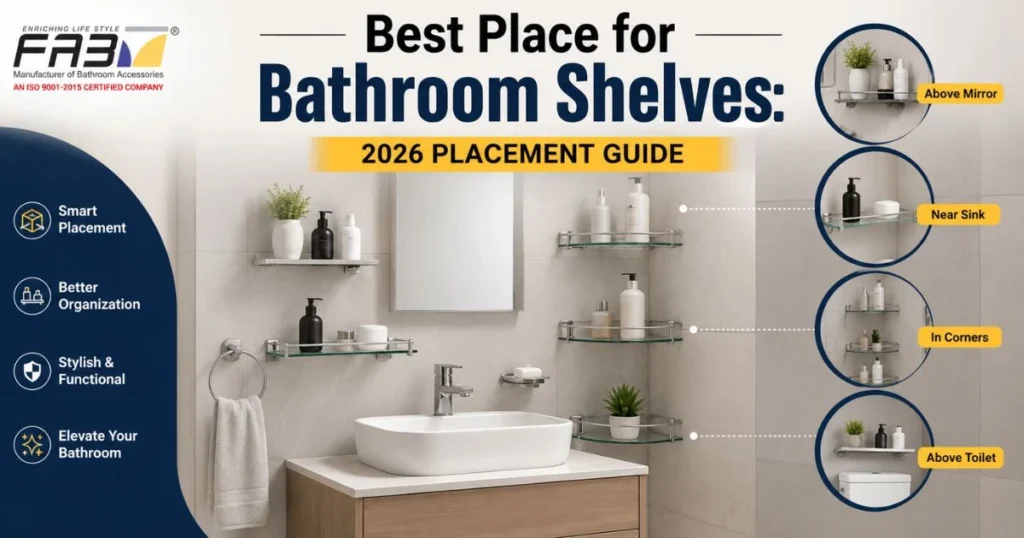
Best Place for Bathroom Shelves: 2026 Placement Guide

Most bathroom shelf guides answer the wrong question. They tell you what a shelf should look like — never where it should actually go, or why that placement fails within a year in a humid bathroom. If you’ve ever watched a “premium” floating shelf sag, rust at the brackets, or grow a faint white crust near the screws, the problem was never the shelf. It was where it was mounted and what it was mounted with. This guide by Fab Bath Interiors fixes that gap. Instead of another style roundup, it gives you a placement framework built around moisture exposure — the one variable that decides whether your bathroom shelf lasts five years or five months. The best place for bathroom shelves depends on how much direct water exposure that spot gets, not on how much wall space is free. Shelves inside the shower or above the tub need fully corrosion-resistant materials and hardware. The Shelves near the sink need moderate moisture protection. Shelves away from all water sources — above the door, on a dry wall — can use almost any material, including wood. The 3-Zone Placement Method At Fab Bath, every placement question starts the same way: which zone is this shelf actually in? We split every bathroom into three zones based on direct water contact, not aesthetics. Zone Water Exposure Typical Locations Material Rule Wet Zone Direct, constant Inside shower, above bathtub Fully waterproof only — brass or stainless steel Splash Zone Indirect, frequent Above sink, beside vanity, near tub rim Corrosion-resistant metal or sealed hardware Dry Zone Minimal to none Above door, hallway-facing wall, over toilet Flexible — wood, MDF, glass, or metal This one distinction — wet, splash, or dry — solves 90% of “why did my shelf rust/sag/mold” complaints before installation even begins. 💡 Key Insight: A shelf’s finish tells you nothing about its zone-readiness. Chrome-plated steel looks identical to solid stainless steel on day one — the difference only shows up after the first few months of humidity. Zone 1 — The Wet Zone The Wet Zone is inside the shower enclosure or directly above the bathtub. Water sits here constantly, not occasionally. What works: Solid brass or 304-grade stainless steel brackets and shelf frames. Brass resists corrosion naturally, which suits wet environments like showers, though it adds weight compared to stainless steel. Stainless steel, meanwhile, tends to tarnish less under humidity when it carries higher chromium content, though cheaper grades can still oxidise. What fails here: Chrome-plated steel, painted MDF, and untreated wood. These absorb moisture at the edges first, then swell or flake from the inside out. Placement rule: Keep Wet Zone shelves at shoulder height or below shower-head spray radius where possible — direct spray shortens the life of even corrosion-resistant hardware. Zone 2 — The Splash Zone This is the area within roughly 60cm of the sink, tub rim, or shower door — close enough to catch splashes and steam, but not direct water flow. What works: Brass, stainless steel, tempered glass with sealed brackets, or powder-coated metal rated for wet rooms. What to avoid: Standard drywall anchors and non-stainless screws. Steam condenses here daily even when no water physically touches the shelf. Placement rule: Vanity-side shelves in the Splash Zone typically sit 20–30cm above counter height — high enough to avoid direct splash, low enough to stay within easy reach. Zone 3 — The Dry Zone Anything above the door, on a wall facing away from the shower, or over the toilet (where steam rarely settles directly) falls into the Dry Zone. What works: Wood, MDF, laminate, or any decorative shelf material — this is the one zone where aesthetics can lead the decision instead of material science. Placement rule: Dry Zone shelves are the right spot for anything that shouldn’t get wet at all — spare towels, decorative items, or storage boxes. Visit Our Glass Shelves Collection — Tell us your layout, we’ll tell you the best place for bathroom shelves and material in 24 hours. Wall-Mounted vs Floating vs Corner Shelves Shelf Type Needs a Stud? Weight Capacity Best Zone Install Difficulty Wall-mounted (bracketed) Preferred, not mandatory with anchors High Wet & Splash Moderate Floating (concealed bracket) Usually yes Medium Splash & Dry Higher Corner shelf Optional Low–Medium Wet Zone (shower corners) Low Freestanding No High Any zone None Corner shelves are the best place for bathroom shelves to work especially well in the Wet Zone because they use the two existing walls of a shower stall as support, reducing the hardware exposed to constant water. Brass vs Stainless Steel vs Glass for Shelf Hardware The bracket and screws matter more than the shelf surface itself — hardware fails before the shelf material does. Material Corrosion Resistance Maintenance Look Best Use Solid Brass High — brass resists corrosion well in humid environments and carries natural anti-microbial properties Occasional polishing Warm, classic Wet & Splash Zone, traditional bathrooms Stainless Steel (304-grade) High — performs well in humid or coastal settings when properly maintained Low Sleek, modern Wet Zone, minimalist bathrooms Tempered Glass (sealed frame) Medium — depends on frame metal Low Open, spacious Splash & Dry Zone Chrome-plated Steel Low High Shiny (short-term) Dry Zone only Both brass and stainless steel outperform chrome-plated steel long-term, but they solve different problems. Brass leans toward warmth and a traditional finish that develops character with age. Stainless steel leans toward a cleaner, more contemporary look with slightly lower upfront maintenance. Mounting Mistakes That Ruin Shelves Early Even the right material fails if the installation ignores humidity. The most common mistakes we see: How Much Weight Can a Bathroom Shelf Hold? A single stud-mounted bracket typically holds 10–15kg safely; a floating shelf on hollow-wall anchors usually caps around 5–7kg. Glass shelves with metal brackets sit lower still — treat manufacturer weight ratings as a ceiling, not a target. Small Bathroom Placement Ideas When floor and wall space is tight, placement does more work than shelf size: FAQ for Best Place

Best Place for Bathroom Shelves: 2026 Placement Guide Read More »

bathroom directions as per vastu

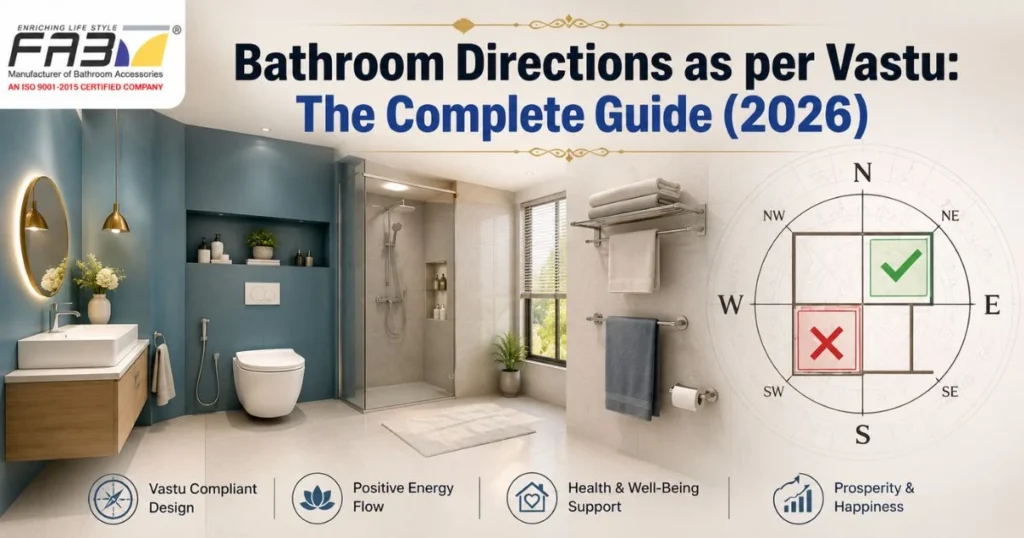
Bathroom Directions as per Vastu: The Complete Guide (2026)

Most homeowners pick bathroom fittings before they ever check the room’s orientation — and then wonder why the space never feels right. Bathroom directions as per vastu exist precisely to solve this: they map how water, air, and energy move through a home, and a bathroom placed against that flow is believed to disrupt the balance of the entire house. If you’re renovating, buying a flat, or simply trying to understand why your current bathroom “feels off,” this guide by Fab Bath Interiors breaks down exactly which directions work, which don’t, and — more usefully — what to do when you’re stuck with a layout you can’t change. What Vastu Says About Bathroom Direction Bathroom directions as per vastu are governed by the eight-zone compass system used across traditional Indian architecture. Each zone is linked to an element — water, fire, air, earth — and a bathroom’s job is to remove waste and stale energy without disturbing zones tied to wealth, health, or rest. That is the whole logic in one sentence. In practice, what we find at Fab Bath Interiors is that clients rarely ask “which direction” until after the fittings are already installed. By then, the room’s orientation is fixed, and the only real lever left is fixture placement, colour, and drainage flow — not structural change. This is exactly why direction alone isn’t the full answer; how you fit out the room matters just as much. 💡 Key Insight: Vastu treats the bathroom as an “exit” zone for water and waste energy — so the north-west and south-east corners, associated with air and fire respectively, are traditionally considered the safest placements. Direction-Wise Dos and Don’ts Here is a structured breakdown of how each compass direction is treated under bathroom directions as per vastu principles, along with the practical reasoning behind each rule. Direction Vastu Verdict Reasoning Practical Note North-West (NW) Recommended Associated with air movement, supports waste removal Best zone for a full bathroom, especially attached ones South-East (SE) Recommended Fire element zone, considered self-cleansing for water use Works well for bathrooms with geysers or water heaters North Acceptable Linked to water and wealth, needs careful fixture placement Keep the toilet seat away from the exact north corner East Acceptable Morning sun supports natural disinfection Favour east if NW or SE aren’t available South Avoid where possible Fire-earth clash, considered to trap stagnant energy If unavoidable, prioritise strong ventilation South-West (SW) Avoid Considered the “stability” zone of the home, easily disturbed Reserved for master bedrooms, not bathrooms, in most traditional layouts North-East (NE) Avoid Sacred zone associated with clarity and health Widely regarded as the least suitable position for any bathroom This table is the fastest way to check an existing floor plan or a builder’s layout before finalising fittings. Best and Worst Bathroom Directions as per vastu Explained The north-west corner consistently comes up as the top recommendation across traditional vastu texts, largely because the air element there supports the outward movement that a bathroom is meant to encourage. South-east follows closely, since its fire association is read as naturally purifying for a space built around water use. At the other end, north-east is almost universally flagged as the direction to avoid for bathroom directions as per vastu. This zone is tied to mental clarity and health in most schools of vastu, and placing a waste-and-water space there is seen as working directly against the home’s energy balance. South-west carries a similar caution, since it’s the zone associated with grounding and stability — qualities a bathroom’s constant water flow is thought to unsettle. None of this means a north-east or south-west bathroom makes a home unlivable. It simply means the remedial layer — covered further down — becomes essential rather than optional. Mirror Position as per Vastu Mirror position as per vastu is a detail most bathroom guides skip entirely, even though it’s one of the easiest fixes homeowners can make without touching plumbing or walls. The core rule: a mirror should never directly face the toilet seat or the main door, since both are considered points where negative energy exits — reflecting that energy back into the room is thought to cancel out the exit’s purpose. The ideal mirror position as per vastu is on the east or north wall, ideally positioned at a height where the average adult sees their full face without stooping. This isn’t just symbolic — east-facing mirrors catch natural morning light, which genuinely improves how the fitting performs day to day. Quick answer: for correct mirror placement as per vastu, mount it on the east or north wall, keep it clear of the toilet seat’s direct line, and avoid placing it opposite the entry door. A second detail practitioners flag often: mirror frame material affects more than aesthetics. Brass frames, in particular, are traditionally associated with the fire and earth elements, which is one reason they’re a repeated choice in vastu-conscious bathroom fit-outs rather than plastic or acrylic frames. What If Your Bathroom Is Already in the Wrong Direction This is the question competitor guides answer least well, and it’s the one that actually matters for most homeowners. If your bathroom sits in the north-east or south-west zone and relocation isn’t realistic, here’s what actually helps: What most guides don’t tell you is that fixture-level choices — tap placement, mirror height, drain positioning — carry almost as much weight in practical vastu correction as the room’s original orientation. You can’t move a wall. You can absolutely move a mirror. Fittings and Fixtures That Support Good Vastu Since Fab Bath Interiors works directly with brass bathroom accessories, this is the layer we see homeowners get wrong most often: treating fittings as a purely aesthetic decision, separate from the direction and placement rules already fixed in the room. A few fixture-level guidelines that align with bathroom directions as per vastu principles: In practice, these are small specification choices — but they’re the ones a homeowner can still control long after the

Bathroom Directions as per Vastu: The Complete Guide (2026) Read More »

bathroom colour trends

Bathroom Colour Trends 2026: The Finishing Guide by Fab Bath

Most homeowners choose a wall colour first and treat their tap and handle finish as an afterthought. That order is backwards. A freshly painted bathroom in the “right” 2026 shade can still look unfinished if the hardware fights the wall instead of working with it — and almost none of the trend round-ups online actually explain which finish belongs with which colour, or why. We manufacture brass bathroom accessories out of Jamnagar, so we see this mismatch daily: the same sage-green vanity paired with a finish that clashes, simply because nobody told the buyer that hardware and colour are one decision, not two. This guide by Fab Bath Interiors fixes that gap. Bathroom colour trends for 2026 describe the seasonal shift in wall, tile, and fixture colour palettes that designers and manufacturers expect homeowners to favour this year — currently moving away from stark whites and cool greys toward warmer neutrals, muted greens, and deeper accent tones paired with textured, patina-friendly hardware finishes. What’s Actually Changing in Bathroom Colour Trends for 2026 For the past several years, bathroom design leaned cool: icy blues, stark whites, charcoal greys. That’s reversing. Warmer, nature-inspired palettes are now taking centre stage, with cozy neutrals like creamy ivory and soft beige, plus earthier tones like terracotta and clay, ranking among the most sought-after choices. Sherwin-Williams’ own 2026 Colour of the Year — Universal Khaki — captures this exact shift toward grounded, mid-tone warmth. Interior designers are also seeing 2026 palettes prioritise texture over polish: zellige tiles, limewash plaster, travertine, and tadelakt are replacing the flat, glossy surfaces that dominated the last decade. In practice, what we find is that clients now ask for a finish recommendation before they finalise a colour — the two decisions have merged into one conversation, and that’s the real story behind this year’s bathroom colour trends. Key Insight: The single biggest bathroom colour trends shift for 2026 isn’t a new shade — it’s those shades no longer being chosen independently of hardware finish, tile texture, or lighting temperature. The 6 Bathroom Colour Trends to Know Here’s what’s actually appearing on moodboards and spec sheets for bathroom colour trends in 2026: None of these are complete strategies on their own. A trending colour without the right finish, lighting, and texture pairing is just a paint chip — not a finished bathroom. Bathroom Colors for Small Bathrooms Small bathrooms behave differently from full-size ones, and most colour-trend content ignores this entirely. The most common mistake we see is homeowners chasing a deep, saturated 2026 trend colour in a windowless powder room and ending up with a space that feels smaller, not richer. For compact bathrooms: This is where the small-bathroom version of bathroom colour trends diverges most from the full-bathroom version: restraint matters more than the shade itself. The Hardware Finish Pairing Table Nobody Publishes This is the gap. Every article on bathroom colour trends stops at paint and tile. As a brass manufacturer, we build the fittings that sit against those colours every day — and the pairing logic below is what we actually specify to clients, not generic styling advice. 2026 Colour Trend Recommended Hardware Finish Why It Works Warm white / cream Unlacquered brass Unlacquered brass develops a natural patina over time, giving the hardware a living finish that deepens the character of the metal — it warms a cream palette rather than competing with it. Greige Brushed brass or brushed nickel Brushed brass photographs well and ages gracefully, pairing easily with both light and dark cabinetry, making it the safest match for a balanced grey-beige base. Sage / muted green Antique bronze or matte black Bronze brings warmth and depth and pairs beautifully with deep green, complementing the growing preference for natural, layered materials. Deep charcoal / midnight blue Polished brass or matte black Deep, saturated shades pair well with polished brass or chrome, with the contrast helping the hardware stand out against a rich cabinet colour. Terracotta / clay Antique or hammered brass The warm, textured surface of hammered brass echoes the handmade, earthy quality of terracotta instead of looking mass-produced against it. Dusty pink / blush Warm gold or champagne brass Soft metallics keep the palette elevated rather than tipping it toward a “nursery” look. Key Insight: Working with brass daily, we’ve noticed unlacquered brass patinas noticeably faster in humid coastal cities like Mumbai or Kochi than in drier climates like Delhi or Jaipur — a detail that changes which finish we recommend depending on region, and one that generic colour-trend guides never mention. Bathroom Colour Schemes 2026, by Style Rather than picking a single trending colour, most designers are now building full bathroom colour schemes for 2026 around one of three directions: Each of these bathroom colour schemes solves a different brief — calm and resale-safe, elevated and layered, or deliberately dramatic. Choosing between them is really a question of how long you plan to live with the result. The 3-Layer Colour Test — Our Framework for Choosing a Scheme That Won’t Date After specifying fittings for hundreds of bathroom projects, we use a simple three-question filter before recommending any colour, and it applies to any home, not just ours: A colour scheme that passes all three rarely needs replacing before the next full renovation — which is the actual goal, not just matching this year’s moodboard. Get a Free Bathroom Fittings Spec Sheet See exactly which brass finish suits your chosen 2026 colour palette, replied within 24 hours. Request your spec sheet. FAQs What colour is trending for bathrooms in 2026?  Warm whites, greige, muted sage green, and earthy terracotta are the dominant bathroom colour trends for 2026, replacing the stark whites and cool greys that were common in previous years. What is the best colour scheme for a small bathroom?  Warm-neutral bases like cream or light greige work best in small bathrooms because they reflect available light. Deep, saturated trend colours should be reserved for a single accent wall or vanity rather

Bathroom Colour Trends 2026: The Finishing Guide by Fab Bath Read More »

Scroll to Top