


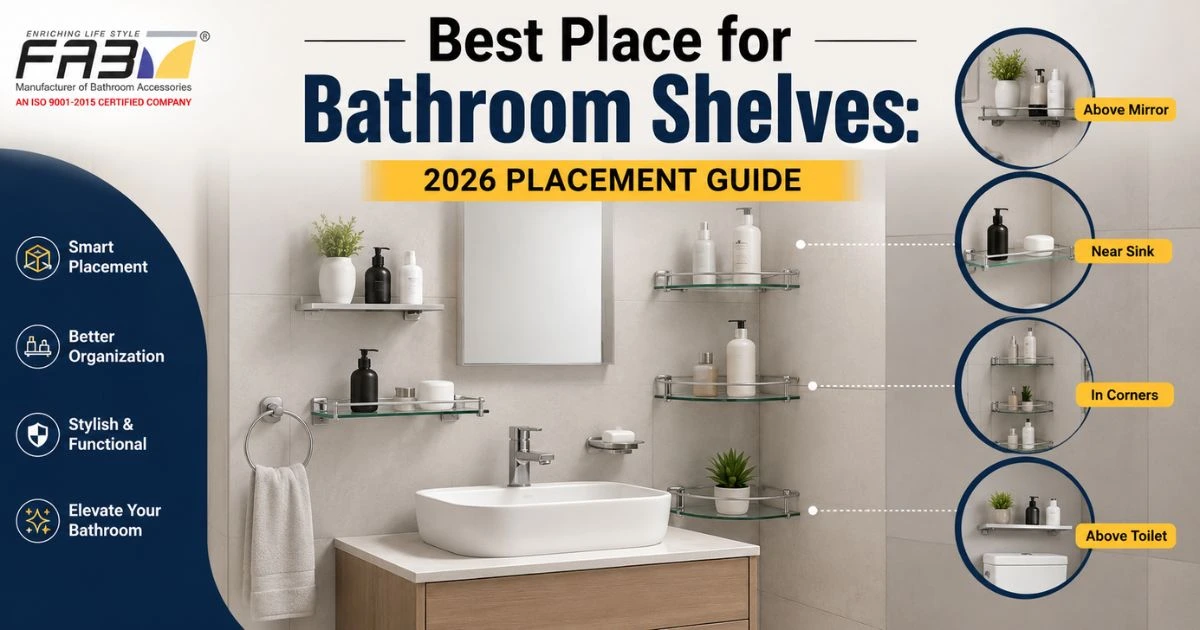
Most bathroom shelf guides answer the wrong question. They tell you what a shelf should look like — never where it should actually go, or why that placement fails within a year in a humid bathroom. If you’ve ever watched a “premium” floating shelf sag, rust at the brackets, or grow a faint white crust near the screws, the problem was never the shelf. It was where it was mounted and what it was mounted with.
This guide by Fab Bath Interiors fixes that gap. Instead of another style roundup, it gives you a placement framework built around moisture exposure — the one variable that decides whether your bathroom shelf lasts five years or five months.
The best place for bathroom shelves depends on how much direct water exposure that spot gets, not on how much wall space is free. Shelves inside the shower or above the tub need fully corrosion-resistant materials and hardware. The Shelves near the sink need moderate moisture protection. Shelves away from all water sources — above the door, on a dry wall — can use almost any material, including wood.
The 3-Zone Placement Method
At Fab Bath, every placement question starts the same way: which zone is this shelf actually in? We split every bathroom into three zones based on direct water contact, not aesthetics.
| Zone | Water Exposure | Typical Locations | Material Rule |
| Wet Zone | Direct, constant | Inside shower, above bathtub | Fully waterproof only — brass or stainless steel |
| Splash Zone | Indirect, frequent | Above sink, beside vanity, near tub rim | Corrosion-resistant metal or sealed hardware |
| Dry Zone | Minimal to none | Above door, hallway-facing wall, over toilet | Flexible — wood, MDF, glass, or metal |
💡 Key Insight: A shelf’s finish tells you nothing about its zone-readiness. Chrome-plated steel looks identical to solid stainless steel on day one — the difference only shows up after the first few months of humidity.
Zone 1 — The Wet Zone
The Wet Zone is inside the shower enclosure or directly above the bathtub. Water sits here constantly, not occasionally.
What works: Solid brass or 304-grade stainless steel brackets and shelf frames. Brass resists corrosion naturally, which suits wet environments like showers, though it adds weight compared to stainless steel. Stainless steel, meanwhile, tends to tarnish less under humidity when it carries higher chromium content, though cheaper grades can still oxidise.
What fails here: Chrome-plated steel, painted MDF, and untreated wood. These absorb moisture at the edges first, then swell or flake from the inside out.
Placement rule: Keep Wet Zone shelves at shoulder height or below shower-head spray radius where possible — direct spray shortens the life of even corrosion-resistant hardware.
Zone 2 — The Splash Zone
This is the area within roughly 60cm of the sink, tub rim, or shower door — close enough to catch splashes and steam, but not direct water flow.
What works: Brass, stainless steel, tempered glass with sealed brackets, or powder-coated metal rated for wet rooms.
What to avoid: Standard drywall anchors and non-stainless screws. Steam condenses here daily even when no water physically touches the shelf.
Placement rule: Vanity-side shelves in the Splash Zone typically sit 20–30cm above counter height — high enough to avoid direct splash, low enough to stay within easy reach.
Zone 3 — The Dry Zone
Anything above the door, on a wall facing away from the shower, or over the toilet (where steam rarely settles directly) falls into the Dry Zone.
What works: Wood, MDF, laminate, or any decorative shelf material — this is the one zone where aesthetics can lead the decision instead of material science.
Placement rule: Dry Zone shelves are the right spot for anything that shouldn’t get wet at all — spare towels, decorative items, or storage boxes.
Visit Our Glass Shelves Collection — Tell us your layout, we’ll tell you the best place for bathroom shelves and material in 24 hours.
Wall-Mounted vs Floating vs Corner Shelves
| Shelf Type | Needs a Stud? | Weight Capacity | Best Zone | Install Difficulty |
| Wall-mounted (bracketed) | Preferred, not mandatory with anchors | High | Wet & Splash | Moderate |
| Floating (concealed bracket) | Usually yes | Medium | Splash & Dry | Higher |
| Corner shelf | Optional | Low–Medium | Wet Zone (shower corners) | Low |
| Freestanding | No | High | Any zone | None |
Corner shelves are the best place for bathroom shelves to work especially well in the Wet Zone because they use the two existing walls of a shower stall as support, reducing the hardware exposed to constant water.
Brass vs Stainless Steel vs Glass for Shelf Hardware
The bracket and screws matter more than the shelf surface itself — hardware fails before the shelf material does.
| Material | Corrosion Resistance | Maintenance | Look | Best Use |
| Solid Brass | High — brass resists corrosion well in humid environments and carries natural anti-microbial properties | Occasional polishing | Warm, classic | Wet & Splash Zone, traditional bathrooms |
| Stainless Steel (304-grade) | High — performs well in humid or coastal settings when properly maintained | Low | Sleek, modern | Wet Zone, minimalist bathrooms |
| Tempered Glass (sealed frame) | Medium — depends on frame metal | Low | Open, spacious | Splash & Dry Zone |
| Chrome-plated Steel | Low | High | Shiny (short-term) | Dry Zone only |
Both brass and stainless steel outperform chrome-plated steel long-term, but they solve different problems. Brass leans toward warmth and a traditional finish that develops character with age. Stainless steel leans toward a cleaner, more contemporary look with slightly lower upfront maintenance.
Mounting Mistakes That Ruin Shelves Early
Even the right material fails if the installation ignores humidity. The most common mistakes we see:
- Regular steel screws instead of stainless. Ordinary steel screws corrode in bathroom humidity, while stainless steel screws resist it despite the small added cost.
- No sealant at the wall joint. A bead of silicone between the shelf’s back edge and the wall stops moisture from seeping behind it, which is where mold typically starts.
- Mixing metals without insulation. Pairing brass hardware with stainless steel fixtures (or vice versa) directly against each other in a wet zone can trigger galvanic reactions over time — always use a nylon washer or sealant barrier between dissimilar metals.
- Skipping the stud when weight is high. Toggle bolts work for light Dry Zone shelves, but anything holding more than a few kilograms in the Wet or Splash Zone needs a stud or a rated wall anchor.
How Much Weight Can a Bathroom Shelf Hold?
A single stud-mounted bracket typically holds 10–15kg safely; a floating shelf on hollow-wall anchors usually caps around 5–7kg. Glass shelves with metal brackets sit lower still — treat manufacturer weight ratings as a ceiling, not a target.
Small Bathroom Placement Ideas
When floor and wall space is tight, placement does more work than shelf size:
- Above the door — Dry Zone space almost every bathroom wastes; ideal for spare towels or rarely-used items.
- Corner shower shelves — use existing tile corners, minimal new hardware.
- Over the toilet — Dry-to-Splash boundary; keep it 12–15cm above the tank for clearance.
- Recessed niche — built into the wall during renovation, keeps the Wet Zone clutter-free without adding depth.
- Vanity side-mount — Splash Zone shelf that uses unused space beside the mirror instead of the counter.
FAQ for Best Place For Bathroom Shelves
Which is the best place for bathroom shelves?
Match the shelf’s material to its zone first. Wet Zone spots (inside the shower, above the tub) need brass or stainless steel hardware. Splash Zone spots near the sink can use sealed glass or metal. Dry Zone spots — above the door, over the toilet — allow more flexible materials like wood.
Is brass or stainless steel better for bathroom shelves in humid climates?
Both resist corrosion well when solid and correctly finished. Brass tends to develop a protective patina over time and suits warmer, traditional finishes. Stainless steel generally needs less polishing and suits a cleaner, modern look. Either outperforms chrome-plated steel long-term.
Can I install bathroom shelves without hitting a stud?
Yes, for lighter Dry Zone shelves using stainless steel toggle bolts or rated wall anchors. For Wet or Splash Zone shelves carrying real weight, a stud mount or a heavy-duty rated anchor is safer.
How high should a bathroom shelf be above the sink?
Roughly 20–30cm above the counter surface works for most vanities — high enough to avoid splash, low enough to stay within easy reach.
Do bathroom shelves need waterproof brackets?
Only in the Wet and Splash Zones. Dry Zone shelves, like ones above the door or over a low-steam area, can use standard hardware since they rarely make direct contact with water or steam.
Which is the best place for bathroom shelves in a small bathroom?
In a small bathroom, the best place for bathroom shelves is the Dry Zone space you’re already wasting — above the door, over the toilet tank, or beside the mirror.
Talk to Fab Bath About Your Bathroom Layout — Get zone-matched brass and steel hardware recommendations, no obligation.