


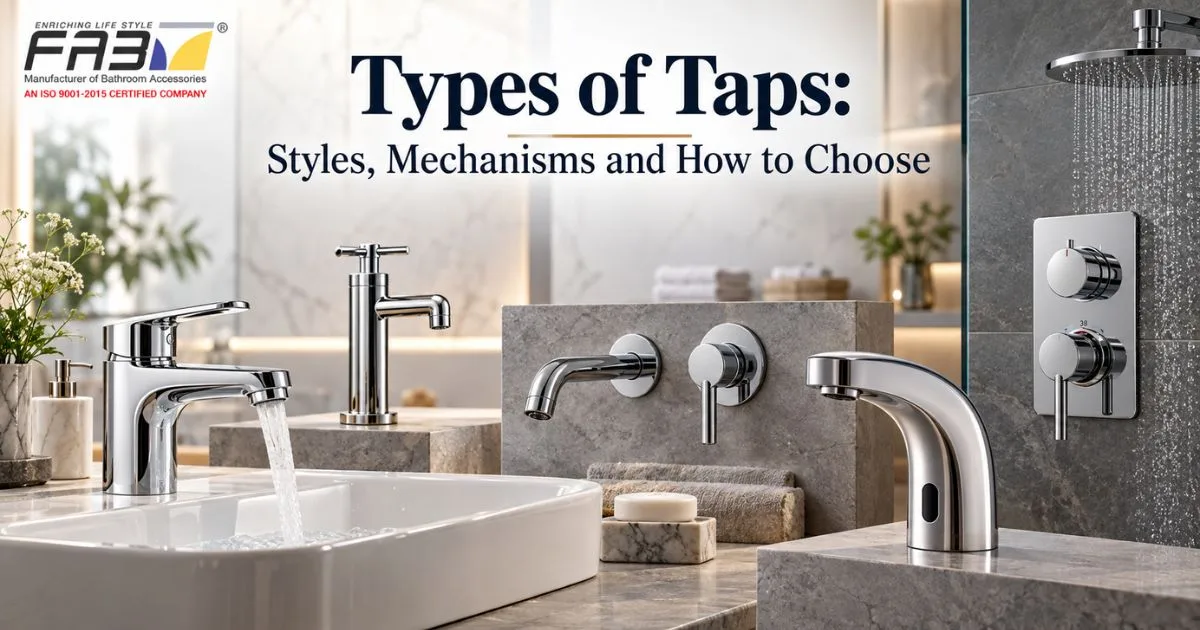
Most homes use one of six main types of taps: pillar, mixer, bib, wall-mounted, sensor or pull-out. Each type differs in how it mixes water, how it mounts, and where it works best.
- How it works: A tap opens an internal valve, and a washer, cartridge or ceramic disc controls flow and temperature.
- When to use it: Pillar taps suit basins, mixers blend water, and bib taps serve outdoors.
- What it involves: Cost and lifespan depend on mechanism and material, and brass with ceramic lasts longest.
Choosing a tap sounds simple. However, the wrong choice causes leaks, splashing and a poor sink fit. This guide explains every major style in plain language. It also covers internal mechanisms, materials, water-saving standards and buying tips. As a result, you can match a tap to your sink, your water pressure and your budget.
Fab Bath Interiors manufactures brass bathroom fittings in Jamnagar, India. The company supplies buyers across Europe, the Middle East and South-East Asia. That production experience shapes the practical advice below.
What Are the Main Types of Taps?
Taps fall into three groups. First, the design and mounting style decides how a tap looks and fits. Second, the internal mechanism decides how it opens, closes and ages. Third, the body material decides strength and safety. Therefore, all three groups matter when you compare types of taps.
For example, a bathroom mixer and a garden bib tap can both use a ceramic cartridge. However, their shapes, mounting points and finishes differ completely. The sections below cover each group in turn. Use them as a quick reference before you buy, replace or specify any tap.
Types of Taps by Design and Mounting
Seven styles cover almost every home, hotel and commercial project. Each one solves a different sink, wall or workflow problem.
Pillar Taps
Pillar taps use two separate handles, one for hot water and one for cold. Each handle sits on its own base over a sink hole. As a result, the water mixes only in the basin, not inside the tap. Many buyers love this classic look. In addition, pillar taps suit traditional bathrooms and heritage interiors. However, you cannot fine-tune the temperature with one hand. Some users also find the split flow awkward for face washing.
Mixer Taps
Mixer taps blend hot and cold water inside one spout. You set the temperature with one lever or two handles. Consequently, the water leaves at the right heat without a second adjustment. Single-lever mixers work well in modern kitchens and bathrooms. Moreover, they save time and water. However, mixers need reasonably balanced hot and cold pressure. Otherwise, one supply can dominate the other.
Monobloc Taps
A monobloc tap combines the spout and handle in one compact unit. It fits through a single hole in the sink or countertop. Therefore, it looks clean and suits small basins well. Cleaning is also easier because the tap has fewer gaps. Technically, a monobloc is a mixer tap. Yet it needs only one drilled hole, which simplifies installation.
Bib Taps
A bib tap has a horizontal inlet and a downward spout. It mounts on a wall, usually outdoors or in utility areas. Gardens, garages and laundry rooms commonly use bib taps. Because the design is simple, these taps cost less and repair quickly. Also, many versions accept a hose connector.
Wall-Mounted Taps
Wall-mounted taps come out of the wall instead of the sink or countertop. This keeps the counter clear and looks sleek. For example, designers often pair them with vessel basins. However, the plumbing sits inside the wall, so installation needs planning. Repairs are harder, too. Therefore, choose a high-quality body from the start.
Sensor Taps
Sensor taps open automatically when a hand comes near. They switch off soon after use. As a result, they cut water waste and reduce surface contact. Airports, hospitals and offices use them widely. In addition, homes with young children or older adults benefit from touch-free control. However, sensor taps need batteries or mains power, and that adds maintenance.
Pull-Out and Pull-Down Taps
These types of taps have a spray head on a flexible hose. You pull the head toward the sink or pot. Consequently, rinsing and cleaning become far easier. Kitchen sinks use them most often. Furthermore, dual-function heads switch between a stream and a spray. Check the hose weight and retraction, because a weak counterweight causes sagging.
Types of Taps by Internal Mechanism
The mechanism inside a tap decides how smoothly it turns and how long it lasts. Four designs dominate the market. Compression taps press a rubber washer onto a seat to stop the flow. Ball taps use a slotted ball to control mixing. Cartridge taps slide a stem inside a sealed unit. Ceramic disc taps rotate two polished discs against each other.
| Mechanism | How it seals | Handle action | Upkeep |
| Compression | Rubber washer on a seat | Several turns | Washers wear out and need replacing |
| Ball | Slotted ball in the body | Single lever | Many small seals can leak over time |
| Cartridge | Sliding stem in a sealed unit | Single lever | Replace the whole cartridge |
| Ceramic disc | Two polished ceramic discs | Quarter turn or lever | Very durable and rarely drips |
Overall, ceramic disc cartridges give the best balance of smooth feel and durability. In contrast, compression taps cost less but drip once the washer hardens. Therefore, buyers who want low maintenance should look for ceramic disc mechanisms inside a solid brass body.
Pillar vs Mixer vs Monobloc Taps: Which Should You Choose?
Pillar, mixer and monobloc taps are the three closest choices for a bathroom basin. The table below compares them side by side.
| Feature | Pillar tap | Mixer tap | Monobloc tap |
| Sink holes needed | Two | One to three | One |
| Water mixing | In the basin | Inside the spout | Inside the spout |
| Best for | Traditional bathrooms | Kitchens and modern bathrooms | Compact basins and counters |
| Cleaning effort | Higher, with more gaps | Moderate | Lowest |
In short, pick a pillar tap for period styling and a mixer for blended water. Pick a monobloc for compact sinks. However, the number of holes in your sink often makes the final decision. Measure it first, because drilling porcelain or stone is risky.
Best Types of Taps for Bathroom, Kitchen and Outdoor Use
Every room asks something different from a tap. Match the style to the task, not just the look.
Bathroom Basins and Showers
The best types of taps for a bathroom basin are monobloc mixers and pillar taps. Monoblocs suit compact vanities. Pillar taps suit classic sets. For a shower or bath, choose a wall-mounted mixer with a diverter. Meanwhile, guest bathrooms and commercial washrooms benefit from sensor taps, since they limit touch and waste.
Kitchen Sinks
Kitchens demand a taller spout and more movement. Therefore, pull-out and swivel-spout mixers work best. A long reach lets you fill pots and rinse sink corners. Also, look for a spray head with a stream option. Choose a heavy, solid body so the hose retracts smoothly for years.
Outdoor and Utility Areas
Outdoor spaces need tough, simple taps. Bib taps in solid brass resist weather and corrosion. Similarly, frost-resistant or long-stem designs help in cold regions. Additionally, a hose connector makes garden use easier. Fit an isolation valve inside the house, so you can shut off the supply during repairs.
Why Brass Is a Top Material for Taps
Brass is an alloy of copper and zinc. It resists corrosion, machines cleanly and takes chrome, gold and matte finishes well. As a result, most premium types of taps use a brass body. Stainless steel also resists rust and suits modern styling. Zinc alloy usually costs less but often wears faster. Plastic suits only light-duty or temporary use.
Jamnagar is widely known as India’s brass city. Every serious brass items manufacturer in Jamnagar works with casting, CNC machining and plating. Quality control at each stage keeps threads accurate and finishes even.
Safety matters as much as strength. According to the U.S. Environmental Protection Agency, lead-free fixtures may contain no more than 0.25 percent lead. That figure is a weighted average across wetted surfaces. This means importers selling taps into the United States should request proof of compliance before they place an order.
Water Efficiency: What Tap Standards Say
Whichever of the types of taps you choose, a water-saving model pays for itself quietly. According to the U.S. EPA WaterSense program, labeled bathroom faucets flow at 1.5 gallons per minute or less. That is about 5.7 litres, compared with the standard 2.2 gallons, or about 8.3 litres.
The same source says replacing old faucets and aerators saves the average family 700 gallons a year. That is roughly 2,650 litres. In other words, an efficient tap lowers both water bills and water-heating costs, and it needs no change in habits.
Aerators are the simplest upgrade. They mix air into the stream, so the flow feels full while using less water. Aerators work with most types of taps, and many mixers include one. You can also retrofit an aerator onto an older tap in minutes.
How to Choose the Right Tap
Follow these six checks before you shortlist any of these types of taps. They prevent most costly mistakes.
- Count the sink holes. One hole suits a monobloc. Two holes suit pillar taps or a two-handle mixer.
- Check your water pressure. Mixers need balanced hot and cold supplies, while low-pressure homes may need a different model.
- Pick the mechanism. Ceramic disc cartridges give the longest, smoothest service.
- Choose the body material. Solid brass offers the best mix of strength, safety and finish quality.
- Match the finish. Chrome is easy to clean, while matte black and brushed gold hide fingerprints better.
- Ask for certification. Request lead-free proof and flow-rate data from every supplier.
Popular Tap Finishes and Where They Work
Finish changes both style and upkeep. Chrome remains the most common choice because it resists stains and wipes clean fast. Matte black suits modern interiors, although it can show water marks. Brushed nickel hides fingerprints and pairs well with neutral tones. Gold and antique brass finishes add warmth to classic or boutique spaces.
However, cheap plating peels over time. Therefore, ask how the manufacturer applies its nickel and chrome layers. Multi-stage plating gives a harder, longer-lasting surface. Also, request a salt-spray test result if the taps will serve coastal or humid regions.
How to Maintain Your Taps
Good habits extend the life of all types of taps by years. First, wipe the surface with a soft cloth and mild soap. Avoid abrasive pads because they scratch the plating. Next, soak the aerator in vinegar every few months to remove limescale. In addition, replace washers or cartridges at the first sign of a drip. A small drip wastes water every day, so act early. Finally, check the shut-off valves once a year. A stiff valve is hard to close in an emergency, so turn each one and confirm it moves freely.
Frequently Asked Questions About Types of Taps
What are the main types of taps?
The main types of taps are pillar, mixer, monobloc, bib, wall-mounted, sensor and pull-out taps.
Which tap mechanism lasts the longest?
Ceramic disc cartridges usually last longest because the polished discs seal without rubber washers.
What is the difference between a mixer tap and a pillar tap?
A mixer tap blends water inside the spout, while a pillar tap keeps hot and cold separate.
Are brass taps better than stainless steel taps?
Brass plates more easily and stainless steel resists rust, so both work well when built properly.
How can I tell whether a tap is lead-free?
Ask the supplier for certification showing a weighted average lead content of 0.25 percent or less on wetted surfaces.
Conclusion
The right tap depends on your sink, your pressure and your daily routine. Pillar taps bring classic charm, mixers add comfort, and monoblocs save space. Meanwhile, bib, wall-mounted, sensor and pull-out designs solve specific jobs. Ceramic disc cartridges and solid brass bodies deliver the longest service. Now that you know the main types of taps, you can compare options with confidence and buy once.
Follow us:- Facebook , Instagram.
You May Also Like This – Types of Mortise Handles