Quick Enquiry
whatapp icon
phone call

Fab Bath Interiors

Looking For Bulk Orders @ Competitive Prices? Enquiry Now

Download Our Latest Products Catalogue Click Here

info@fabbathinteriors.com

Bathroom Accessories Supplier in India

top 10 bathroom fittings brands in india

Top 10 Bathroom Fittings Brands in India 2026 | Guide by Fab Bath

Most “top 10 bathroom fittings brands in india” lists are recycled from the same five sources, ranked by ad spend rather than actual product quality. That’s the gap. Anyone shortlisting fittings for a new build or renovation ends up comparing brand logos instead of brass grades, plating durability, or after-sales warranty terms — the things that actually determine whether a tap survives five years of hard water. This guide by Fab Bath Interiors fixes that by ranking brands on material specification, not marketing budget, and by explaining exactly what separates a ₹500 fitting from a ₹5,000 one. If you’re sourcing at scale — for a hotel project, a builder pipeline, or a distribution network — this comparison also flags which brands actually export-grade their brass and which sell the same SKU under two different quality tiers. Top 10 bathroom fittings brands in India refers to the manufacturers and suppliers most commonly specified by architects, builders, and interior designers for taps, showers, faucets, and bathroom hardware across residential and commercial projects in India, ranked by material quality, finish durability, and after-sales support. How We Ranked These Brands Most comparison articles rank brands by search volume or affiliate commission. We ranked on four criteria that actually predict how a fitting performs after installation: Top 10 Bathroom Fittings Brands in India Compared Brand Known For Typical Price Tier Best Suited For Jaquar Wide retail network, design range Mid-Premium Residential, mid-size builders Kohler Premium design, sanitaryware + fittings Premium Luxury residential, hospitality Hindware Value-for-money, broad SKU range Entry-Mid Mass housing, budget renovation Cera Affordable, growing distribution Entry Budget projects, tier-2/3 cities Parryware Roca-backed, consistent quality Mid Residential, apartments Grohe German engineering, premium cartridges Premium Luxury residential, commercial Roca Spanish design heritage Premium Hospitality, high-end residential Essco Industrial-grade, project supply Mid Commercial, institutional Marc Contemporary design focus Mid-Premium Residential, boutique projects Fab Bath Interiors Brass-grade specification transparency, project-based sourcing Mid-Premium Builders and suppliers who need documented brass composition, not just a brand name This isn’t a paid ranking, and price tier isn’t the same as quality — a Cera fitting installed correctly with the right brass grade will outlast a mismatched premium fitting installed with the wrong valve seat. What matters more than the logo is the next section. Brass Grade — The Spec Sheet Detail Nobody Explains Here’s what most buyers never ask, and what most spec sheets never volunteer: not all “brass” fittings use the same brass. In practice, what we find is that most buyers never see this distinction written anywhere on the packaging — it only shows up if you ask the manufacturer directly or read the technical data sheet, which almost nobody does before purchase. This is exactly why brands selling into hard-water regions or export markets specify grade 385 as a baseline, while brands competing purely on shelf price default to 360. 💡 Key Insight: If your project is in a hard-water zone — most of North India qualifies — ask for the brass grade in writing before ordering, not just the finish type. Table Snippet: Brass Grade Comparison Property Grade 360 Grade 385 Copper content ~60% ~63-65% Corrosion resistance Moderate High Machinability Excellent Good Typical use case Entry/mid fittings Premium/export fittings Common in Budget retail SKUs Architectural, hospitality, export Branded vs Unbranded — What You’re Actually Paying For Ready your budget for a genuinely useful comparison, not a brand-loyalty pitch. Plain talk: what does the brand name actually buy you? What it does not automatically buy you is better brass. Several regional and B2B suppliers — including Fab Bath Interiors, working out of Jamnagar’s brass manufacturing belt — supply grade-385 fittings at a lower markup because they sell direct to builders and distributors rather than through multi-layer retail channels. The most common mistake we see is buyers assuming “unbranded” means “lower quality,” when in Jamnagar’s manufacturing ecosystem it often means “fewer markup layers between the factory and the buyer.” How to Choose a Bathroom Accessories Supplier in India If you’re sourcing at project scale rather than buying one tap for a home renovation, the decision changes. A good Bathroom Accessories Supplier in India should be evaluated on different criteria than a retail brand. Quick answer: for project sourcing, prioritize a supplier who provides written brass-grade documentation, holds consistent stock for repeat orders, and offers direct factory pricing — not necessarily the supplier with the most recognizable brand name. Here’s the checklist we recommend to builders and distributors evaluating a Bathroom Accessories Supplier in India: Vastu Considerations for Bathroom Fittings Placement Since fittings and bathroom layout decisions are often made together in Indian residential projects, it’s worth noting: Vastu Shastra principles generally recommend bathroom fittings — taps, showers — positioned toward the east or north walls, with the drainage point oriented northeast where possible. This is a design and cultural consideration, separate from material quality, and worth discussing with your architect alongside the fittings selection itself. Frequently Asked Questions Which brass grade is best for bathroom fittings in hard-water areas?  Brass Grade 385 is better suited to hard-water regions because of its higher copper content and stronger resistance to dezincification.  Is a more expensive bathroom fittings brand always better quality?  Not necessarily. Price often reflects brand marketing, retail markup, and design range rather than material composition alone. What is the difference between a bathroom fittings brand and a bathroom accessories supplier? A Bathroom Accessories Supplier in India, especially manufacturer-linked suppliers, often sells directly to builders and distributors at factory pricing, with more flexibility on customization and bulk documentation but less retail-facing brand recognition. How do I verify the brass grade of fittings before buying?  Request a material composition certificate directly from the manufacturer or supplier. Legitimate suppliers, including project-focused ones like Fab Bath Interiors, can provide this on request. Do all top 10 bathroom fittings brands in India use the same manufacturing standards? No. While most established brands comply with baseline ISI and IS 8931 standards for plating and pressure ratings, brass grade, cartridge type, and finish durability

Top 10 Bathroom Fittings Brands in India 2026 | Guide by Fab Bath Read More »
Bathroom Accessories Manufacturer

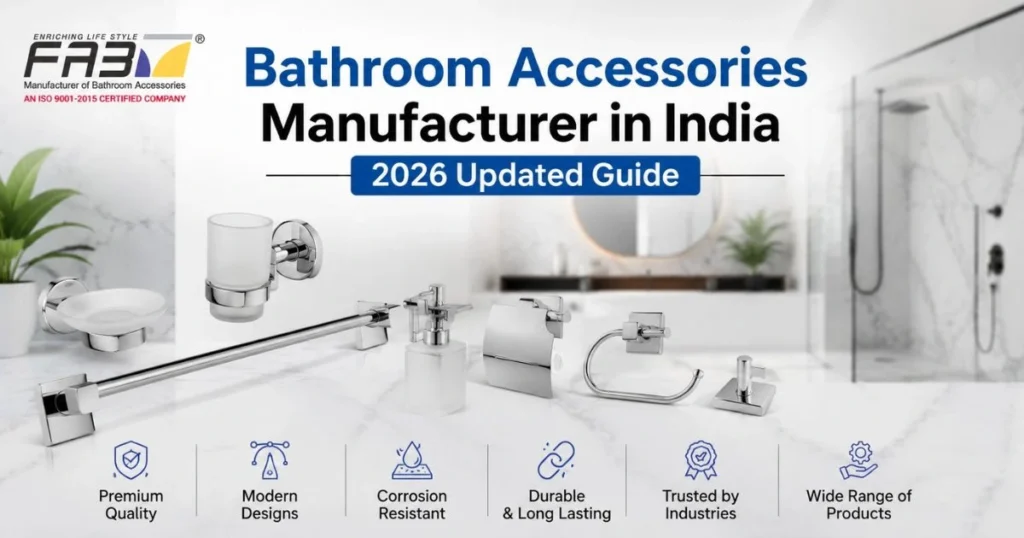
Bathroom Accessories Manufacturer in India: 2026 Updated Guide

Sourcing a bathroom accessories manufacturer sounds simple until your shipment gets stuck at customs over a missing certification, or your “solid brass” order turns out to be a zinc-alloy substitute. If you’ve been burned by inconsistent quality or vague MOQs before, you already know why the right manufacturing partner matters more than the lowest quote. This guide by Fab Bath Interiors breaks down what separates a dependable bathroom accessories manufacturer from a risky one, why India — and Jamnagar specifically — has become the default sourcing destination, and what to check before you sign a purchase order. What Makes a Bathroom Accessories Manufacturer Reliable in 2026? A reliable bathroom accessories manufacturer controls its own casting, machining, and finishing in-house rather than outsourcing to unverified job workers. This matters because quality consistency drops sharply the moment production gets split across subcontractors with no shared quality standard. Look for three things first: vertical integration, documented certifications, and a traceable production history. A manufacturer that owns its extrusion and CNC machining can hold tighter tolerances and catch defects earlier. In contrast, a trading company that simply resells factory output usually cannot tell you which unit made your specific batch. Reputation also comes from longevity. Manufacturers with multiple decades in operation have typically weathered raw material price swings, changing import regulations, and shifting buyer expectations — and adjusted their processes accordingly. That track record is worth more than a polished catalog. Why Is India Becoming the World’s Preferred Bathroom Accessories Manufacturer Hub? India dominates this space primarily because of Jamnagar, Gujarat, where a single industrial cluster produces the overwhelming majority of the country’s brass output. According to Anand Brass’s industry guide, Jamnagar is home to more than 5,000 brass manufacturing units and produces an estimated 60 to 65 percent of India’s total brass output. Some industry sources place that figure even higher, citing roughly 80% of India’s brass exports coming from the city. This concentration didn’t happen overnight. Jamnagar’s brass industry traces back to the early 20th century, when local artisans produced brass utensils and decorative items, before the sector shifted toward industrial components in the 1960s and 1970s as India’s electrical, plumbing, and automotive sectors grew. Consequently, the region built a complete supply chain — foundries, extrusion mills, CNC shops, and plating units — all within a small radius. Geography reinforces this advantage. Jamnagar sits within 200–300 km of Mundra Port, India’s largest private port, and Kandla Port, enabling cost-effective shipping to the US, Europe, the Middle East, and Asia. As a result, lead times for international buyers stay competitive even against manufacturers based closer to major consumption markets. The global demand story supports this positioning too. Grand View Research reports the global bathroom accessories market was valued at roughly USD 24.6 billion in 2024 and is projected to reach approximately USD 46.2 billion by 2030, growing at a CAGR of 11.2%. Notably, India is expected to register the highest CAGR of any country in this market between 2025 and 2030, which signals both rising domestic demand and expanding export capacity. What Should You Look for in a Bathroom Accessories Supplier in India? A trustworthy bathroom accessories supplier in India will show you certifications before you ask. Request ISO 9001:2015 as a baseline, then check for product-specific compliance depending on your target market — CE for Europe, WRAS for UK water fittings, or BIS/ISI marks for domestic Indian sales. Beyond paperwork, ask about defect rates and rework policy. Established Jamnagar exporters commonly report rejection rates under 1%, verified through periodic industry audits, alongside typical turnaround times of 2–4 weeks for custom orders. If a supplier can’t quote you a defect rate, that itself is a red flag. Finally, verify export experience against your specific destination market. A manufacturer well-versed in shipping to the Gulf may not have the same familiarity with EU REACH documentation or US customs bonds. Ask for references from buyers in your region specifically, not just a generic client list. Data Table 1: Global Bathroom Accessories Market Size Comparison (2024–2032) Source Base Year Value Forecast Value CAGR Forecast Period Grand View Research USD 24.6B (2024) USD 46.2B (2030) 11.2% 2025–2030 Fortune Business Insights USD 27.75B (2025) USD 73.1B (2034) 11.37% 2026–2034 Stratistics MRC USD 22.0B (2026) USD 38.0B (2034) 7.1% 2026–2034 This table answers: How large is the global bathroom accessories market, and how fast is it growing? Figures vary by methodology, but every major research house agrees on double-digit or near-double-digit expansion through the early 2030s. How Does a Bathroom Accessories Exporter Handle International Certification and Compliance? A serious bathroom accessories exporter builds compliance into production, not as an afterthought before shipping. Lead-free brass compositions, for instance, need to be verified at the alloy stage — not tested only on the finished product, since retesting after the fact can delay entire shipments. Gujarat’s state government has also invested directly in this capability. The Gujarat Brass Policy 2025 channeled ₹500 crore into R&D clusters focused on innovations like lead-free brass for water safety. This kind of institutional backing gives Jamnagar-based exporters an edge in meeting drinking-water and plumbing safety standards required by markets like the US and EU. Sustainability compliance is increasingly part of the conversation too. Many Jamnagar exporters recycle over 70% of their raw material inputs, supporting client ESG requirements, while several units have adopted solar-powered melting furnaces that cut carbon footprints by roughly 40%. If your buyer scorecard includes environmental criteria, ask suppliers directly about their energy mix and recycled content percentage. Data Table 2: Certification Checklist for Bathroom Accessories Sourcing Certification What It Verifies Relevant Market ISO 9001:2015 Quality management system Global baseline RoHS Restriction of hazardous substances EU, UK WRAS Water fitting safety UK BIS/ISI Product safety standard India domestic PPAP Level 3 Production part approval, traceability Automotive-adjacent OEM buyers This table answers: Which certifications should I request from a bathroom accessories manufacturer before placing an order? What Materials Do Leading Bathroom Accessories Manufacturers Use? Brass remains the material of choice for premium bathroom

Bathroom Accessories Manufacturer in India: 2026 Updated Guide Read More »

Scroll to Top