


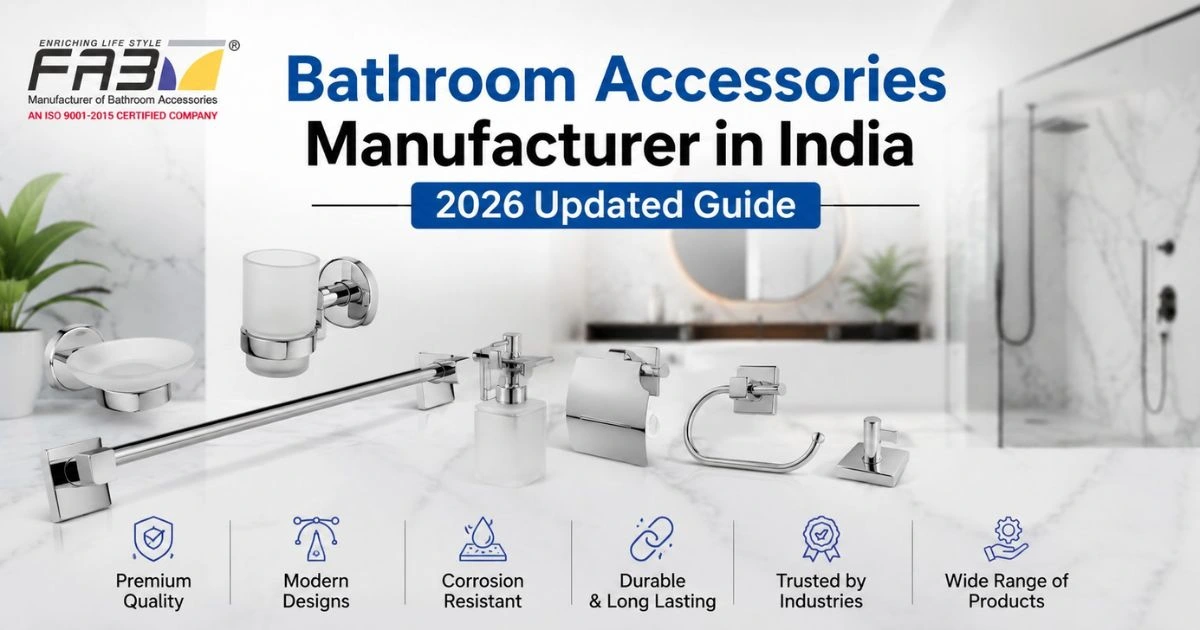
Sourcing a bathroom accessories manufacturer sounds simple until your shipment gets stuck at customs over a missing certification, or your “solid brass” order turns out to be a zinc-alloy substitute. If you’ve been burned by inconsistent quality or vague MOQs before, you already know why the right manufacturing partner matters more than the lowest quote.
This guide by Fab Bath Interiors breaks down what separates a dependable bathroom accessories manufacturer from a risky one, why India — and Jamnagar specifically — has become the default sourcing destination, and what to check before you sign a purchase order.
What Makes a Bathroom Accessories Manufacturer Reliable in 2026?
A reliable bathroom accessories manufacturer controls its own casting, machining, and finishing in-house rather than outsourcing to unverified job workers. This matters because quality consistency drops sharply the moment production gets split across subcontractors with no shared quality standard.
Look for three things first: vertical integration, documented certifications, and a traceable production history. A manufacturer that owns its extrusion and CNC machining can hold tighter tolerances and catch defects earlier. In contrast, a trading company that simply resells factory output usually cannot tell you which unit made your specific batch.
Reputation also comes from longevity. Manufacturers with multiple decades in operation have typically weathered raw material price swings, changing import regulations, and shifting buyer expectations — and adjusted their processes accordingly. That track record is worth more than a polished catalog.
Why Is India Becoming the World’s Preferred Bathroom Accessories Manufacturer Hub?
India dominates this space primarily because of Jamnagar, Gujarat, where a single industrial cluster produces the overwhelming majority of the country’s brass output. According to Anand Brass’s industry guide, Jamnagar is home to more than 5,000 brass manufacturing units and produces an estimated 60 to 65 percent of India’s total brass output. Some industry sources place that figure even higher, citing roughly 80% of India’s brass exports coming from the city.
This concentration didn’t happen overnight. Jamnagar’s brass industry traces back to the early 20th century, when local artisans produced brass utensils and decorative items, before the sector shifted toward industrial components in the 1960s and 1970s as India’s electrical, plumbing, and automotive sectors grew. Consequently, the region built a complete supply chain — foundries, extrusion mills, CNC shops, and plating units — all within a small radius.
Geography reinforces this advantage. Jamnagar sits within 200–300 km of Mundra Port, India’s largest private port, and Kandla Port, enabling cost-effective shipping to the US, Europe, the Middle East, and Asia. As a result, lead times for international buyers stay competitive even against manufacturers based closer to major consumption markets.
The global demand story supports this positioning too. Grand View Research reports the global bathroom accessories market was valued at roughly USD 24.6 billion in 2024 and is projected to reach approximately USD 46.2 billion by 2030, growing at a CAGR of 11.2%. Notably, India is expected to register the highest CAGR of any country in this market between 2025 and 2030, which signals both rising domestic demand and expanding export capacity.
What Should You Look for in a Bathroom Accessories Supplier in India?
A trustworthy bathroom accessories supplier in India will show you certifications before you ask. Request ISO 9001:2015 as a baseline, then check for product-specific compliance depending on your target market — CE for Europe, WRAS for UK water fittings, or BIS/ISI marks for domestic Indian sales.
Beyond paperwork, ask about defect rates and rework policy. Established Jamnagar exporters commonly report rejection rates under 1%, verified through periodic industry audits, alongside typical turnaround times of 2–4 weeks for custom orders. If a supplier can’t quote you a defect rate, that itself is a red flag.
Finally, verify export experience against your specific destination market. A manufacturer well-versed in shipping to the Gulf may not have the same familiarity with EU REACH documentation or US customs bonds. Ask for references from buyers in your region specifically, not just a generic client list.
Data Table 1: Global Bathroom Accessories Market Size Comparison (2024–2032)
| Source | Base Year Value | Forecast Value | CAGR | Forecast Period |
| Grand View Research | USD 24.6B (2024) | USD 46.2B (2030) | 11.2% | 2025–2030 |
| Fortune Business Insights | USD 27.75B (2025) | USD 73.1B (2034) | 11.37% | 2026–2034 |
| Stratistics MRC | USD 22.0B (2026) | USD 38.0B (2034) | 7.1% | 2026–2034 |
How Does a Bathroom Accessories Exporter Handle International Certification and Compliance?
A serious bathroom accessories exporter builds compliance into production, not as an afterthought before shipping. Lead-free brass compositions, for instance, need to be verified at the alloy stage — not tested only on the finished product, since retesting after the fact can delay entire shipments.
Gujarat’s state government has also invested directly in this capability. The Gujarat Brass Policy 2025 channeled ₹500 crore into R&D clusters focused on innovations like lead-free brass for water safety. This kind of institutional backing gives Jamnagar-based exporters an edge in meeting drinking-water and plumbing safety standards required by markets like the US and EU.
Sustainability compliance is increasingly part of the conversation too. Many Jamnagar exporters recycle over 70% of their raw material inputs, supporting client ESG requirements, while several units have adopted solar-powered melting furnaces that cut carbon footprints by roughly 40%. If your buyer scorecard includes environmental criteria, ask suppliers directly about their energy mix and recycled content percentage.
Data Table 2: Certification Checklist for Bathroom Accessories Sourcing
| Certification | What It Verifies | Relevant Market |
| ISO 9001:2015 | Quality management system | Global baseline |
| RoHS | Restriction of hazardous substances | EU, UK |
| WRAS | Water fitting safety | UK |
| BIS/ISI | Product safety standard | India domestic |
| PPAP Level 3 | Production part approval, traceability | Automotive-adjacent OEM buyers |
What Materials Do Leading Bathroom Accessories Manufacturers Use?
Brass remains the material of choice for premium bathroom accessories because of its corrosion resistance, weight, and finish versatility. Unlike zinc alloy, which can pit or corrode faster in humid bathroom environments, properly treated brass holds chrome, matte black, and brushed nickel finishes for years without visible degradation.
That said, material choice still depends on price point and application. Budget product lines often use zinc alloy or ABS plastic with a metallic coating, which lowers cost but shortens product lifespan. Plastic currently holds the largest material share globally, at roughly 29.9%, driven by affordability and lightweight manufacturing — a reminder that not every market segment prioritizes brass, even though it remains the premium standard.
Data Table 3: Material Comparison for Bathroom Accessories
| Material | Corrosion Resistance | Typical Lifespan | Price Tier | Best For |
| Solid Brass | Excellent | 15–25 years | Premium | Hospitality, high-end residential |
| Stainless Steel | Excellent | 15–20 years | Mid-premium | Commercial, coastal humidity |
| Zinc Alloy | Moderate | 5–8 years | Mid-range | Budget residential |
| ABS Plastic | Low (coating-dependent) | 3–5 years | Entry-level | Rental units, low-cost fit-outs |
How Do Jamnagar-Based Manufacturers Ensure Quality at Scale?
Scale and quality usually pull against each other, but Jamnagar’s cluster model solves this through shared infrastructure rather than any single mega-factory. Extrusion plants, CNC machining units, and plating facilities operate as specialized links in a chain, which lets even mid-sized manufacturers access world-class finishing without owning every process themselves.
CNC precision has also improved dramatically. Jamnagar manufacturers now operate CNC lathes and Swiss-type machines capable of tolerances as tight as ±0.004mm, a level of accuracy that matters directly for accessories with moving or threaded components, such as adjustable towel rails or concealed fixing mechanisms.
Buyer audits remain the final safeguard. Before committing to a large order, request either a virtual factory walkthrough or a third-party inspection report. Most established exporters welcome this, since it builds long-term trust rather than one-off transactions.
What Are the Cost Factors When Sourcing from a Bathroom Accessories Supplier in India?
Raw material price is the single biggest cost driver, since brass prices fluctuate with global copper and zinc markets. Locking in a fixed-price contract for 6–12 months, where the supplier agrees to it, protects your margins against sudden metal price spikes.
Order volume changes your unit economics significantly. Smaller MOQs cost more per piece because setup and tooling costs get spread across fewer units. If you’re testing a new market, ask about tiered pricing so you understand exactly where the cost curve flattens.
Shipping and compliance add a final layer. The US, UK, and Australia together account for roughly 86–88% of global brass hardware imports, so exporters serving these markets typically have streamlined documentation processes already in place — which can save you weeks compared to a first-time export relationship.
Data Table 4: Cost Factors in Bathroom Accessories Sourcing
| Factor | Impact on Unit Cost | Mitigation Strategy |
| Raw material volatility | High | Fixed-price 6–12 month contracts |
| Order volume (MOQ) | High at low volumes | Tiered pricing negotiation |
| Certification/testing | Moderate, one-time | Bundle testing across product lines |
| Freight and customs | Moderate | Consolidate shipments, use established export lanes |
Ready to Source Reliable Bathroom Accessories?
If you’re evaluating a bathroom accessories manufacturer for your next order, Fab Bath Interiors offers ISO-aligned brass manufacturing from Jamnagar, with both B2B export and B2C supply capability. Request a Fab Bath Interiors product catalog to compare finishes, MOQs, and certification documentation before you commit.
Conclusion
Choosing a bathroom accessories manufacturer comes down to three checks: verified certifications, in-house production control, and a track record you can independently confirm. India, led by Jamnagar’s brass cluster, has built the infrastructure to meet all three at competitive cost. As global demand keeps climbing through 2026 and beyond, buyers who vet suppliers on process — not just price — will end up with fewer surprises at delivery.
FAQs
What is the leading bathroom accessories manufacturing hub in India?
Jamnagar, Gujarat, is India’s leading bathroom accessories and brass component manufacturing hub, producing the majority of the country’s brass exports.
Is brass better than zinc alloy for bathroom accessories?
Yes, solid brass offers stronger corrosion resistance and a longer lifespan than zinc alloy, typically lasting 15–25 years versus 5–8 years for zinc alloy.
What certifications should I request from a bathroom accessories exporter?
Request ISO 9001:2015 as a baseline, plus market-specific certifications like RoHS for the EU, WRAS for the UK, or BIS for India.
How long does custom manufacturing typically take from an Indian bathroom accessories supplier?
Most established Jamnagar-based manufacturers quote 2–4 weeks for custom orders, depending on order volume and finishing complexity.
Why is India’s bathroom accessories export market growing so fast?
India is projected to post the highest country-level CAGR in the global bathroom accessories market through 2030, driven by rising domestic construction and expanding brass manufacturing capacity in Jamnagar.