


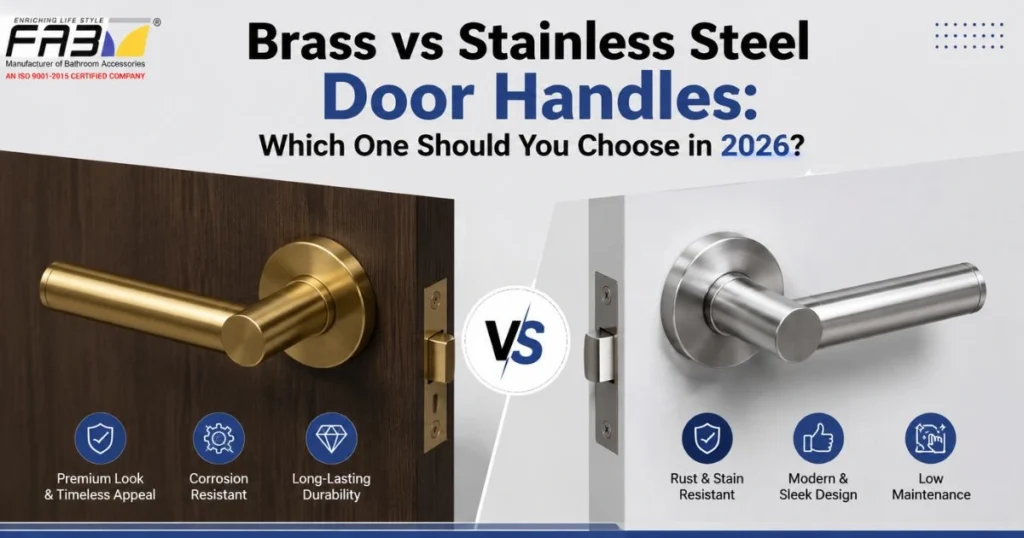
Brass vs Stainless Steel Door Handles: Which One Should You Choose in 2026?
Picture this. You’re standing in a hardware store, staring at two rows of handles. One set gleams warm gold. The other looks cool and clinical. The price tags don’t match either. Meanwhile, your contractor is waiting for an answer. This is exactly where most homeowners get the brass vs stainless steel door handles decision wrong. Not because they lack taste. Rather, because nobody explained what actually separates the two beyond looks. Below, we break down the real differences: durability, hygiene, cost, climate performance, and maintenance. No guesswork. No sales pitch. What Is the Real Difference Between Brass and Stainless Steel Door Handles? Brass is a copper-zinc alloy. It typically contains 60-70% copper. Stainless steel, on the other hand, is an iron alloy. It gets its corrosion resistance from added chromium, and often nickel and molybdenum (source). Similarly, silicon bronze — a related alloy often confused with brass — runs much higher in copper content, between 92% and 96% (source). That copper content is the single biggest factor separating the two materials. It gives brass its warm color. It also gives brass natural resistance to certain types of corrosion. Most importantly, it gives brass a hygiene property stainless steel simply doesn’t have. Stainless steel, by contrast, relies on chromium. Once exposed to oxygen, chromium forms a thin, self-healing oxide layer on the surface. This layer stops rust from forming. As a result, stainless steel has become the default choice for commercial and high-traffic installations. Overall, neither material is objectively “better.” Instead, each one solves a different problem. Which Material Lasts Longer: Brass or Stainless Steel? For most residential and light-commercial use, both materials easily outlast the door they’re fitted to. However, the real question is what kind of wear each one resists. Indoors, and away from salt air, brass wears well against everyday touch and grip pressure. It also resists corrosion for decades. Even so, unlacquered brass will tarnish over time. This happens as the copper reacts with air and moisture. 304 stainless steel contains roughly 18% chromium and 8% nickel. As a result, it offers good corrosion resistance and strong formability for indoor use and mild outdoor conditions. In contrast, 316 stainless steel adds 2-3% molybdenum. This addition sharply improves resistance to chloride-driven pitting and crevice corrosion (source) — the exact failure mode that ruins handles near coastlines or humid coastal cities. In terms of raw surface hardness, 304 stainless steel typically measures 70-90 on the Rockwell B scale. 316, meanwhile, measures slightly higher at 79-95 HRB due to its molybdenum content (source). Brass, comparatively, is softer. This is actually why it machines and casts so cleanly into detailed, ornate designs. Practical takeaway: for a high-traffic commercial door or a coastal exterior, stainless steel — specifically 316 grade — usually wins on raw longevity. For interior doors handled gently and polished regularly, however, brass holds up just as well over a normal building lifecycle. Do Brass Door Handles Really Kill Bacteria? Yes. And this is not a marketing claim. In fact, the U.S. Environmental Protection Agency registered copper alloys, including brass, as the first solid antimicrobial materials in 2008 (source). Specifically, the mechanism is called the oligodynamic effect. Copper ions disrupt bacterial cell walls. They also interfere with DNA and RNA replication, which speeds up microbial death on contact (source). Research shows bacteria can die within minutes to hours on brass surfaces. On stainless steel, however, the same bacteria can survive for days or weeks (source). This is exactly why older hospitals and public buildings historically specified brass door furniture. Not for the aesthetic — for infection control, long before anyone understood germ theory in modern terms. Modern research backs this further. For instance, a 2022 study in the Annals of Clinical Microbiology tested antibacterial effects of copper, brass, and stainless steel against multidrug-resistant bacteria. Likewise, a 2018 paper in the Journal of Applied Microbiology examined the contact-killing properties of copper directly (source list). If you’re specifying hardware for a clinic, a care facility, or a kitchen, this single property is worth factoring into your decision. Stainless steel, in contrast, offers zero antimicrobial benefit on its own. It’s simply a passive, non-reactive surface — clean-looking, but not self-sanitizing. How Do Brass and Stainless Steel Door Handles Compare on Price? Upfront, solid brass hardware usually costs more per unit than standard stainless steel, especially for cast or detailed pieces. Stainless steel typically costs more upfront than budget materials like zinc alloy. Even so, it delivers the lowest long-term replacement cost for large-scale or bulk projects, since it needs almost no ongoing maintenance (source). Brass, by contrast, needs periodic polishing to keep its shine if it’s lacquered. Alternatively, it’s left to patina naturally if unlacquered. Either way, factor that labor cost into any total-cost-of-ownership comparison, particularly for hospitality or commercial properties with dozens of doors. Factor Brass Stainless Steel Typical upfront unit cost Higher for solid/cast pieces Moderate to high depending on grade Long-term maintenance cost Higher (polishing, lacquer reapplication) Low (wipe-clean) Best value at scale Small-to-mid residential projects Large commercial/bulk installations Lifespan with proper care 20+ years indoors 20+ years, longer in humid/coastal zones (316 grade) Table: Cost and lifespan comparison for brass vs stainless steel door handles. Which Material Suits Coastal or Humid Climates? Here, the decision becomes environment-specific. Salt spray can travel 5 km inland or more, depending on wind direction. Furthermore, salt is hygroscopic. It absorbs moisture, and as a result, it accelerates metal corrosion wherever it settles (source). Unlacquered brass reacts quickly to salty, humid air. The copper in the alloy oxidizes with chlorides, and the patina effect sets in fast near the sea. Standard 304 stainless steel isn’t immune either. Notably, 304 grade can develop “tea staining” on a beachfront door — superficial brown rust spots — even though the metal is broadly marketed as rust-resistant (source). 316-grade “marine” stainless steel, with its added molybdenum, is built specifically to resist chloride attack. For this reason, it’s the recommended choice for coastal installations (source). If brass
Brass vs Stainless Steel Door Handles: Which One Should You Choose in 2026? Read More »