


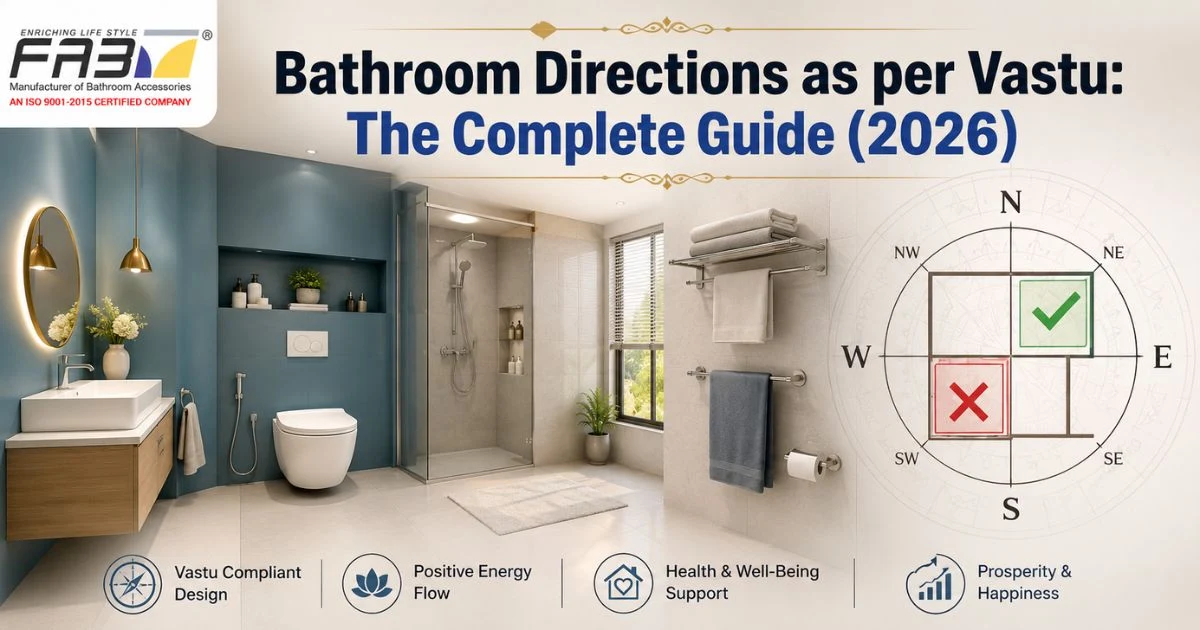
Most homeowners pick bathroom fittings before they ever check the room’s orientation — and then wonder why the space never feels right. Bathroom directions as per vastu exist precisely to solve this: they map how water, air, and energy move through a home, and a bathroom placed against that flow is believed to disrupt the balance of the entire house. If you’re renovating, buying a flat, or simply trying to understand why your current bathroom “feels off,” this guide by Fab Bath Interiors breaks down exactly which directions work, which don’t, and — more usefully — what to do when you’re stuck with a layout you can’t change.
What Vastu Says About Bathroom Direction
Bathroom directions as per vastu are governed by the eight-zone compass system used across traditional Indian architecture. Each zone is linked to an element — water, fire, air, earth — and a bathroom’s job is to remove waste and stale energy without disturbing zones tied to wealth, health, or rest. That is the whole logic in one sentence.
In practice, what we find at Fab Bath Interiors is that clients rarely ask “which direction” until after the fittings are already installed. By then, the room’s orientation is fixed, and the only real lever left is fixture placement, colour, and drainage flow — not structural change. This is exactly why direction alone isn’t the full answer; how you fit out the room matters just as much.
💡 Key Insight: Vastu treats the bathroom as an “exit” zone for water and waste energy — so the north-west and south-east corners, associated with air and fire respectively, are traditionally considered the safest placements.
Direction-Wise Dos and Don’ts
Here is a structured breakdown of how each compass direction is treated under bathroom directions as per vastu principles, along with the practical reasoning behind each rule.
| Direction | Vastu Verdict | Reasoning | Practical Note |
|---|---|---|---|
| North-West (NW) | Recommended | Associated with air movement, supports waste removal | Best zone for a full bathroom, especially attached ones |
| South-East (SE) | Recommended | Fire element zone, considered self-cleansing for water use | Works well for bathrooms with geysers or water heaters |
| North | Acceptable | Linked to water and wealth, needs careful fixture placement | Keep the toilet seat away from the exact north corner |
| East | Acceptable | Morning sun supports natural disinfection | Favour east if NW or SE aren’t available |
| South | Avoid where possible | Fire-earth clash, considered to trap stagnant energy | If unavoidable, prioritise strong ventilation |
| South-West (SW) | Avoid | Considered the “stability” zone of the home, easily disturbed | Reserved for master bedrooms, not bathrooms, in most traditional layouts |
| North-East (NE) | Avoid | Sacred zone associated with clarity and health | Widely regarded as the least suitable position for any bathroom |
Best and Worst Bathroom Directions as per vastu Explained
The north-west corner consistently comes up as the top recommendation across traditional vastu texts, largely because the air element there supports the outward movement that a bathroom is meant to encourage. South-east follows closely, since its fire association is read as naturally purifying for a space built around water use.
At the other end, north-east is almost universally flagged as the direction to avoid for bathroom directions as per vastu. This zone is tied to mental clarity and health in most schools of vastu, and placing a waste-and-water space there is seen as working directly against the home’s energy balance. South-west carries a similar caution, since it’s the zone associated with grounding and stability — qualities a bathroom’s constant water flow is thought to unsettle.
None of this means a north-east or south-west bathroom makes a home unlivable. It simply means the remedial layer — covered further down — becomes essential rather than optional.
Mirror Position as per Vastu
Mirror position as per vastu is a detail most bathroom guides skip entirely, even though it’s one of the easiest fixes homeowners can make without touching plumbing or walls. The core rule: a mirror should never directly face the toilet seat or the main door, since both are considered points where negative energy exits — reflecting that energy back into the room is thought to cancel out the exit’s purpose.
The ideal mirror position as per vastu is on the east or north wall, ideally positioned at a height where the average adult sees their full face without stooping. This isn’t just symbolic — east-facing mirrors catch natural morning light, which genuinely improves how the fitting performs day to day.
Quick answer: for correct mirror placement as per vastu, mount it on the east or north wall, keep it clear of the toilet seat’s direct line, and avoid placing it opposite the entry door.
A second detail practitioners flag often: mirror frame material affects more than aesthetics. Brass frames, in particular, are traditionally associated with the fire and earth elements, which is one reason they’re a repeated choice in vastu-conscious bathroom fit-outs rather than plastic or acrylic frames.
What If Your Bathroom Is Already in the Wrong Direction
This is the question competitor guides answer least well, and it’s the one that actually matters for most homeowners. If your bathroom sits in the north-east or south-west zone and relocation isn’t realistic, here’s what actually helps:
- Improve ventilation aggressively. A north-east or south-west bathroom benefits from an exhaust fan running longer than usual, since airflow is the main counterbalance to a poorly placed water zone.
- Keep the toilet seat off the exact corner. Positioning the seat away from the room’s north-east or south-west corner, even by a foot or two, is a widely used remedial adjustment.
- Use earth-toned or light-coloured tiles. Lighter tones are believed to soften the disruptive effect of a misplaced bathroom, particularly in south-west installations.
- Fix mirror position as per vastu rules regardless of room direction. Even in a poorly placed bathroom, correct mirror placement limits further imbalance.
- Keep the door closed and well-sealed. A tightly closing door restricts the “leak” of negative energy vastu practitioners associate with badly oriented bathrooms.
- Choose fittings in brass or copper-toned finishes. These are traditionally read as grounding materials, often recommended specifically for spaces that can’t meet ideal directional placement.
What most guides don’t tell you is that fixture-level choices — tap placement, mirror height, drain positioning — carry almost as much weight in practical vastu correction as the room’s original orientation. You can’t move a wall. You can absolutely move a mirror.
Fittings and Fixtures That Support Good Vastu
Since Fab Bath Interiors works directly with brass bathroom accessories, this is the layer we see homeowners get wrong most often: treating fittings as a purely aesthetic decision, separate from the direction and placement rules already fixed in the room.
A few fixture-level guidelines that align with bathroom directions as per vastu principles:
- Taps and showers: Position outlets on the east or north wall where possible — this keeps water flow aligned with the directions vastu treats as favourable.
- Geysers and heaters: Best placed in the south-east corner, matching the fire-element association already assigned to that zone.
- Drainage: Should slope toward the north or east, never toward the south-west, regardless of the room’s overall orientation.
- Accessory finish: Brass and copper-toned fittings are the most consistently recommended finishes in vastu-conscious design, largely due to their earth-and-fire element associations.
In practice, these are small specification choices — but they’re the ones a homeowner can still control long after the walls are built and the plumbing is set.
Attached Bathrooms and Bedroom Placement
A frequent follow-up question alongside bathroom directions as per vastu is whether an attached bathroom is acceptable at all. It is — provided the bathroom itself sits in the room’s north-west or west corner, keeping the bedroom’s south-west “stability” zone undisturbed. An attached bathroom placed in the bedroom’s north-east corner is considered the least favourable combination in most traditional layouts, since it stacks two sensitive zones against each other.
For flats and apartments where the builder has already fixed this layout, the remedial steps above — ventilation, mirror position as per vastu correction, and lighter tile tones — apply here too.
Get a Vastu-Friendly Fittings Recommendation — Free Consultation for Your Bathroom Layout
Frequently Asked Questions about bathroom directions as per vastu
Which direction is considered best for a bathroom as per vastu?
North-west and south-east are the two directions most consistently recommended across traditional vastu texts. North-west supports the air element needed for waste removal, while south-east’s fire association is read as naturally purifying for a water-heavy space.
What happens if a bathroom is built in the north-east direction?
North-east is widely considered the least suitable placement, since this zone is linked to clarity and health. A bathroom here isn’t structurally harmful, but vastu practitioners recommend strong ventilation, corner-avoidant fixture placement, and light tile tones as correction.
Where should the mirror be placed in a bathroom as per vastu?
The mirror position as per vastu should be on the east or north wall, at a height suited to the household’s average user, and never directly facing the toilet seat or the main door.
Can a bathroom be located next to or above a kitchen?
Most vastu guidance discourages placing a bathroom directly above or adjacent to a kitchen, since the two spaces represent conflicting elements — water and waste versus fire and nourishment. Where unavoidable, a sealed, well-drained wall between the two is the standard practical fix.
Do bathroom fittings and fixtures actually affect vastu compliance?
Yes — fixture placement, drainage direction, and even accessory finish are treated as meaningful adjustments, especially when the room’s overall direction can’t be changed. Brass and copper-toned fittings, correct tap positioning, and proper mirror position as per vastu rules are the most commonly recommended fixes.
Conclusion
Bathroom directions as per vastu aren’t just about where a room sits on a floor plan — they’re about how water, air, and fixtures work together inside that space. North-west and south-east remain the strongest placements, north-east and south-west the ones to manage carefully, and mirror position as per vastu is one of the simplest corrections available regardless of the room’s orientation. When relocation isn’t an option, the fixture-level choices — brass finishes, tap placement, ventilation, and mirror height — do most of the practical work.