


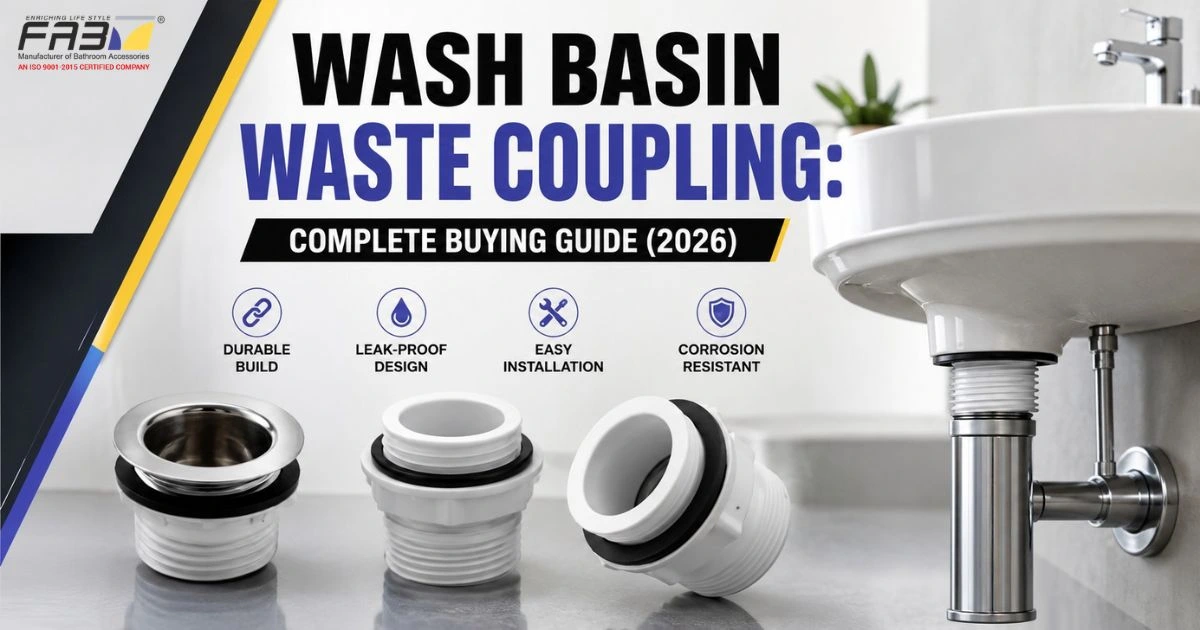
A wash basin waste coupling is a small fitting, but it decides whether a basin drains cleanly for ten years or starts leaking within ten months. This guide by Fab Bath Interiors answers every practical question an Indian homeowner, plumber, or contractor asks before buying one — sizing, materials, price, standards, installation, and common problems — in one place.
What Is a Wash Basin Waste Coupling?
A wash basin waste coupling is the fitting that sits inside a basin’s drain hole and connects the basin outlet to the drainage pipe underneath. It allows wastewater to flow out of the basin while blocking hair, soap residue, and debris from entering the pipe and, in most designs, sealing against sewer gas coming back up.
In practice, most Indian bathrooms use a 32mm wash basin waste coupling, while kitchen sinks need a wider 40mm version because of higher water flow. The fitting has three working parts: a flange (the visible strainer disc), a threaded body, and a locking nut that pulls everything tight against the basin from underneath. Get any one of these mismatched to your basin, and you’ll see water seepage under the vanity within weeks — a callback every plumber wants to avoid.
Homeowners sometimes confuse this fitting with the trap below it, but the two serve different jobs. The coupling seals the basin’s own drain hole and channels water downward; the trap — whether a P-trap or bottle trap — holds a small reservoir of water further down the line to block sewer gas from travelling back up. A basin can have a perfectly sealed coupling and still smell bad if the trap underneath has run dry, which is why the two components are usually inspected together during a service call rather than in isolation.
How Does a Wash Basin Waste Coupling Work?
A wash basin waste coupling works by sitting flush in the drain hole, holding a rubber or fibre washer tight against the basin surface, and channelling water down through its threaded body into the P-trap or bottle trap below. The locking nut, tightened from beneath the basin, is what actually creates the watertight seal — not the coupling’s threads alone.
As a result, correct installation matters as much as the fitting itself. A coupling tightened by hand without a spanner, or seated without plumber’s putty or a rubber gasket, is one of the most common reasons a brand-new wash basin waste coupling starts dripping within the first month of use. Additionally, the strainer or dome-shaped mesh on top is what catches soap flakes and hair before they reach the trap, which is why couplings without a strainer clog drainage lines faster in shared bathrooms.
What Are the Different Types of Wash Basin Waste Couplings?
There are four common types of wash basin waste couplings sold in India today, and each suits a different basin design:
- Standard/strainer waste coupling – no open-close mechanism; water drains freely. Best for utility areas and public washrooms.
- Pop-up waste coupling – opened and closed using a lever near the tap; retains water in the basin temporarily. Common in modern vanity basins.
- Click-clack waste coupling – press-to-open, press-to-close mechanism built into the flange itself, without a separate lever rod.
- Bottle-trap compatible coupling – designed to connect with a visible or concealed bottle trap, used mostly in premium and designer bathroom setups.
However, the mechanism you choose should match how the basin is used. A pedestal basin in a guest bathroom rarely needs a pop-up mechanism, while a countertop basin in a master bath usually looks better with one.
What Size Wash Basin Waste Coupling Do I Need?
Most Indian bathroom basins use a 32mm wash basin waste coupling, while kitchen sinks require a 40mm size because of the higher volume of water they handle. Measuring the drain hole diameter before buying is the single most important step in avoiding a leak.
| Basin/Fixture Type | Standard Coupling Size | Common Installation |
| Pedestal wash basin | 32mm | Full-thread or half-thread, exposed trap |
| Wall-hung basin | 32mm | Concealed or bottle-trap pipework |
| Countertop/vanity basin | 32mm | Usually paired with pop-up coupling |
| Kitchen sink | 40mm (1½”) | Full-thread, higher flow strainer |
In practice, buying the wrong size — even by 2–3mm — is the single biggest cause of returns on e-commerce marketplaces, since a slightly undersized coupling won’t seat against the locking nut properly. When in doubt, check the manufacturer’s product manual rather than estimating by eye.
How Do You Measure Your Basin’s Drain Hole Before Buying?
Measuring a basin’s drain hole correctly before buying a wash basin waste coupling takes less than two minutes and prevents the most common return reason on Indian e-commerce sites: ordering the wrong size.
Use a measuring tape or calliper across the widest point of the drain opening, from inner edge to inner edge, not across the visible rim of the basin. Most pedestal and countertop basins in India measure close to 32mm, while kitchen sink openings measure closer to 40mm. Additionally, check whether a small oval or round overflow hole sits near the top rim of the basin — its presence determines whether you need a half-thread or full-thread coupling, covered in more detail further below. If the basin came with the original fitting still in place, removing and measuring that old coupling directly is usually more reliable than measuring the hole itself, since wear and mineral buildup can distort the opening slightly over years of use.
What Materials Are Wash Basin Waste Couplings Made Of?
Wash basin waste couplings are typically made from brass, stainless steel, or ABS/PVC plastic, and the material you choose directly affects how long the fitting lasts under daily exposure to water, cleaning agents, and humidity.
| Material | Durability | Typical Use Case | Relative Price |
| Brass (chrome/gold-plated) | High – corrosion-resistant, 10+ years | Premium bathrooms, hard water areas | Higher |
| Stainless steel (304 grade) | High – rust-resistant | Mid-range to premium bathrooms | Moderate–High |
| ABS/PVC plastic | Moderate – can degrade with heat/UV | Budget installations, utility areas | Lowest |
Brass fittings conforming to Indian material norms generally use a copper-zinc-tin alloy, which is why brass wash basin waste couplings resist corrosion better in regions with hard or saline groundwater — a real concern in several Indian coastal and industrial belts. Stainless steel, particularly 304-grade, is the next most durable option and is now manufactured domestically by several Indian bath-fitting brands. Plastic couplings are the most affordable but are best reserved for low-visibility, low-use installations rather than a primary bathroom.
Is There an Indian Standard for Wash Basin Waste Couplings?
Yes. Copper-alloy waste fittings for wash basins and sinks sold in India are covered under IS 2963, the Bureau of Indian Standards specification titled “Copper Alloy Waste-Fittings for Wash Basins and Sinks,” maintained by BIS’s Sanitary Appliances and Water Fittings sectional committee (CED 3).
This standard governs the material composition and dimensional accuracy of brass waste fittings, and government procurement platforms explicitly require conformity to it — the Government e-Marketplace, for instance, lists 32mm wash basin waste fittings as requiring IS 2963 conformity and expressly excludes plastic fittings from that procurement category. For homeowners, checking whether a brass coupling references IS 2963 on the packaging is a quick way to separate a genuine metal fitting from a lower-grade alloy sold at a similar price.
How Much Does a Wash Basin Waste Coupling Cost in India?
A wash basin waste coupling typically costs anywhere from ₹150 to ₹1,500 in India, depending on material, finish, and mechanism, with plastic strainer versions at the low end and premium brass pop-up couplings at the top.
| Coupling Type | Approximate Price Range (INR) | Notes |
| Basic PVC/ABS strainer coupling | ₹100 – ₹300 | Budget and utility installations |
| Stainless steel full-thread coupling | ₹250 – ₹700 | Common mid-range choice |
| Brass full-thread coupling | ₹400 – ₹900 | Better corrosion resistance |
| Brass pop-up waste coupling | ₹700 – ₹1,500+ | Premium finishes (matte black, rose gold, chrome) |
As a result, price alone is a poor indicator of quality — a ₹250 stainless-steel coupling from a reputed manufacturer can outlast a ₹600 unbranded brass one if the alloy grade is inferior. Checking for BIS-referenced brass grades or established brand names such as Hindware, Jaquar, or Ruhe is generally a safer filter than price alone.
Full Thread vs Half Thread Waste Coupling: Which One Do I Need?
A full-thread wash basin waste coupling has threading running the entire length of its body, and installers use it for basins without an overflow hole — while a half-thread coupling has threading only on the lower half, designed for basins that do have an overflow hole near the rim.
| Feature | Full-Thread Coupling | Half-Thread Coupling |
| Basin overflow hole | Not required | Required |
| Thread coverage | Entire body length | Lower half only |
| Seal strength | Very tight, secure fit | Reliable, standard fit |
| Common use | Basins without overflow slot | Most standard Indian basins |
However, installers frequently make one site-level mistake: forcing a half-thread coupling into a basin with no overflow hole. This often fails to seal properly at the top of the drain, since the threading doesn’t reach where the locking pressure is needed. Checking for the small oval overflow slot near the basin’s rim before ordering avoids this entirely.
How Do You Install a Wash Basin Waste Coupling?
Installing a wash basin waste coupling involves seating the flange in the drain hole with a sealant, securing it from underneath with a locking nut, and connecting the threaded body to the trap below.
- Apply plumber’s putty or a rubber gasket around the underside of the flange before inserting it into the drain hole.
- Insert the coupling from above and hold it steady while working underneath the basin.
- Thread the locking nut onto the coupling body by hand, then tighten firmly with a spanner — not just by hand.
- Wipe away excess putty that squeezes out around the flange edge.
- Connect the coupling’s threaded outlet to the P-trap or bottle trap, using PTFE tape on the threads.
- Run water for two to three minutes and check underneath for any drips before closing up the vanity.
In practice, the most common installation error is over-tightening the locking nut with pliers instead of a proper basin wrench, which can crack ceramic basins at the drain hole — a repair that costs far more than the fitting itself.
For a wall-hung or countertop basin, the same six steps apply, but access from underneath is often tighter, so many plumbers use a basin wrench with an angled head rather than a standard spanner. Additionally, if the basin connects to a concealed bottle trap rather than an exposed P-trap, it’s worth dry-fitting the parts together before applying sealant — closing the vanity panel makes concealed installations far harder to adjust afterward.
What Are Common Wash Basin Waste Coupling Problems and How Do You Fix Them?
The most common wash basin waste coupling problems are slow drainage, water leaking from underneath the basin, and bad odour rising from the drain — and each traces back to a specific, fixable cause.
- Slow drainage: usually caused by hair or soap scum trapped in the strainer mesh; clean the flange dome monthly to prevent buildup.
- Leaking underneath the basin: almost always a loose locking nut or perished washer; retighten with a spanner or replace the rubber gasket.
- Bad odour: typically means the trap below the coupling has run dry or the seal at the coupling-to-trap joint has failed; check the PTFE tape and trap water level.
- Coupling rotating loosely in the drain hole: this means the installer never properly sealed the flange with putty during installation, and it now needs reseating.
Additionally, in hard-water regions, mineral scale can build up around the flange threads over 3–4 years, making couplings harder to remove for maintenance — a reason many plumbers now prefer stainless steel over unbranded plastic in such areas.
How Do You Maintain a Wash Basin Waste Coupling?
Maintaining a wash basin waste coupling mainly means cleaning the strainer regularly, checking the locking nut for tightness every few months, and avoiding harsh acidic cleaners on brass or chrome finishes.
A simple monthly routine — lifting the pop-up mechanism or unscrewing the strainer dome, clearing trapped debris, and running hot water through the drain — prevents most clogs before they start. Additionally, for pop-up and click-clack mechanisms, periodically checking the connecting rod or lever ensures the drain still opens and closes fully — a partially stuck mechanism often mimics a clogged pipe when the real fault lies in the coupling itself.
Wash Basin Waste Coupling vs Sink Waste Coupling: What’s the Difference?
A wash basin waste coupling and a sink waste coupling perform the same basic function — connecting a fixture’s drain to the plumbing line — but differ in size, finish, and mechanism based on where they’re installed.
Bathroom wash basin waste couplings are generally 32mm, finished in chrome, matte black, or gold to match bathroom hardware, and often feature pop-up mechanisms for water retention. Kitchen sink waste couplings, by contrast, are typically 40mm to handle higher water volume, favour plain strainer designs over pop-up mechanisms, and prioritise corrosion resistance over aesthetic finish, since kitchen sinks see more frequent, heavier use.
You May Visit for this – Fab Bath Interiors Accessories
Ready to Choose the Right Waste Coupling for Your Bathroom?
Getting the size, thread type, and material right the first time saves you a repeat plumber visit and a damaged basin. Fab Bath Interiors’ range of BIS-referenced brass and stainless-steel wash basin waste couplings covers pedestal, wall-hung, and countertop basins in multiple finishes — browse the collection or reach out to our team for help matching a coupling to your exact basin model before you buy.
Conclusion
A wash basin waste coupling may be one of the smallest fittings in a bathroom, but getting the size, thread type, and material right prevents most leaks, odour issues, and clogged drains before they start. Whether you’re a homeowner replacing a worn-out fitting or a plumber specifying fittings for a new build, matching the coupling to the basin’s overflow design and your local water conditions is what determines how long it lasts.
Frequently Asked Questions
Q.1 What size wash basin waste coupling do I need for a standard Indian bathroom?
Most Indian bathroom basins use a 32mm wash basin waste coupling, while kitchen sinks require a 40mm size.
Q.2 Is brass or stainless steel better for a wash basin waste coupling?
Brass generally offers the best corrosion resistance for hard-water areas, while 304-grade stainless steel is a durable, slightly more affordable alternative.
Q.3 How do I know if I need a full-thread or half-thread waste coupling?
Choose a full-thread coupling if your basin has no overflow hole, and a half-thread coupling if it does.
Q.4 Why is my wash basin waste coupling leaking after installation?
A loose locking nut or missing plumber’s putty/gasket seal around the flange most often causes leaks after installation.
Q.5 Is there an Indian standard for wash basin waste couplings?
Yes, BIS specification IS 2963 covers copper-alloy wash basin waste couplings sold in India.